
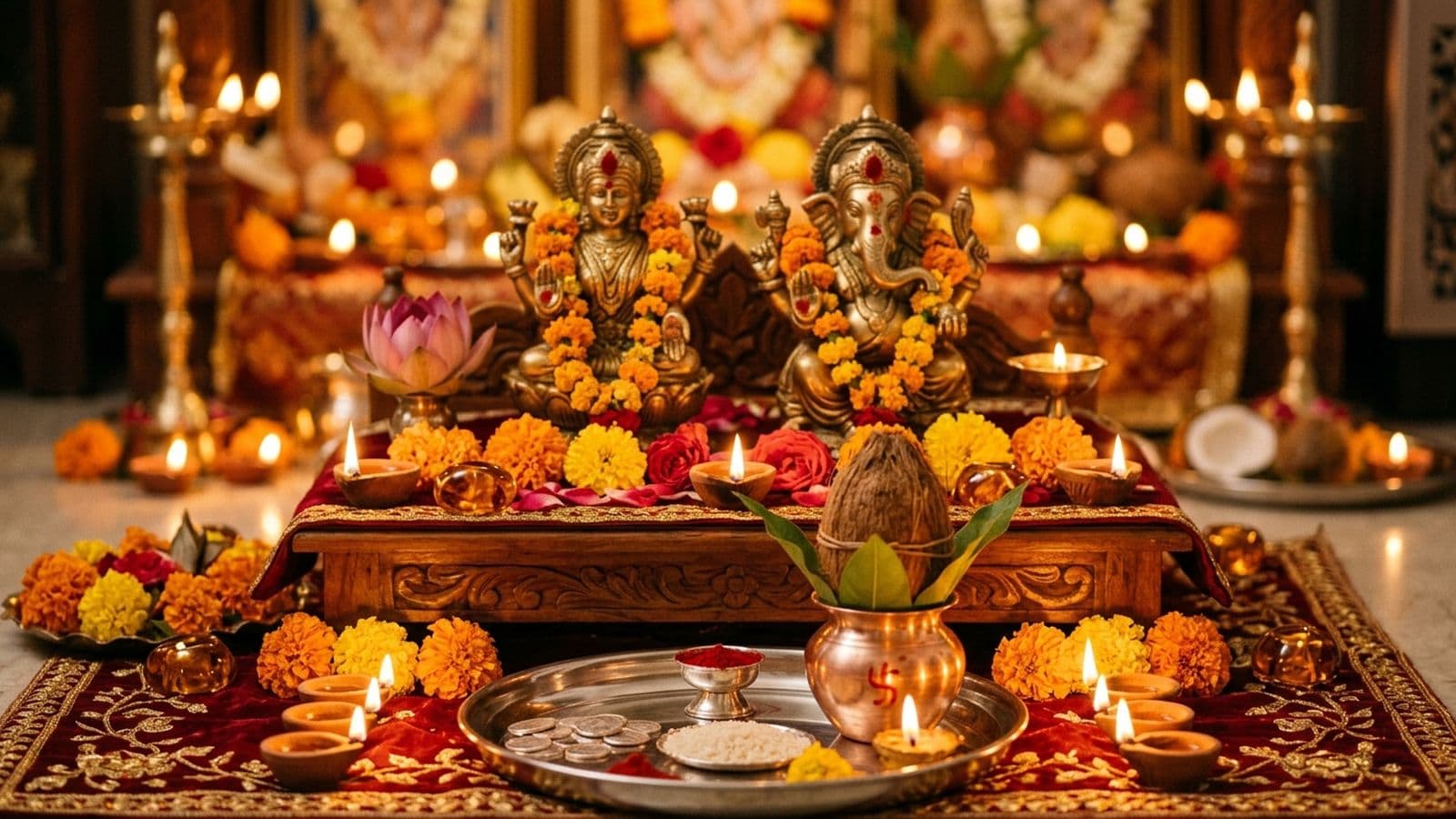
Of all the year's pujas, Diwali Lakshmi Puja is fixed by two conditions at once, not one. It must fall in the pradosh kaal — the roughly two hours and twenty-four minutes after sunset — while the Kartik Amavasya still holds; and within that dusk it is kept, wherever it can be, inside the Vrishabha lagna. Vrishabha is a sthir, a fixed sign, and the reasoning is plain from the intent: a fixed rising sign is said to hold the goddess in the house, so that Lakshmi settles and stays rather than passing through, as she is thought to under a movable sign.
Because pradosh begins at your own sunset, this is not a single national hour. In New Delhi the pradosh runs about 5:31 to 7:55 PM and the ideal Vrishabha window inside it is roughly 5:54 to 7:50 PM; in Mumbai, with its later sunset, pradosh opens later, about 6:01 to 8:25 PM. The date is set by the tithi: Amavasya begins at 11:30 AM on 8 November and ends at 12:33 PM on the 9th, so only the evening of the 8th carries Amavasya through pradosh — by the 9th's dusk the tithi is long over, which is why the puja falls unambiguously on 8 November this year.
Lakshmi Puja 2026 at a glance
Festival day
Sun, 8 November 2026
Tithi
Kartik Amavasya
Lakshmi Puja (pradosh)
Delhi 5:54 – 7:50 PM
Amavasya
8 Nov 11:30 AM → 9 Nov 12:33 PM
Ideal lagna
Vrishabha — a fixed (sthir) sign
Nishita (traders)
Chopda pujan, around midnight
Lakshmi Puja muhurat 2026
The pradosh window and the Vrishabha lagna, by city
New Delhi — Lakshmi Puja
5:54 PM – 7:50 PM
The Vrishabha (sthir) lagna inside pradosh 5:31–7:55, Amavasya prevailing
Mumbai — pradosh kaal
6:01 PM – 8:25 PM
Opens later with the later sunset; the Vrishabha window sits inside it
The muhurat above is the household Lakshmi Puja — the lamp-lit evening puja of the goddess. In New Delhi the ideal window is the Vrishabha lagna, about 5:54 to 7:50 PM, which sits inside the wider pradosh of 5:31 to 7:55 PM; a printed Delhi time is only a guide, because both the pradosh and the Vrishabha rising move with your own sunset. Mumbai's pradosh opens later, 6:01 to 8:25 PM, with its Vrishabha window falling somewhere inside that stretch. Many traders and business families keep a second, later puja — the Chopda or Bahi-khata pujan of the new account books — in the Nishita kaal around midnight; that alternative, and who keeps which, is set out below.
Pradosh or Nishita — who uses which
The household evening puja and the traders' midnight Chopda pujan
Two windows carry Lakshmi Puja, and they belong to two kinds of worshipper. The pradosh kaal, the dusk just after sunset, is the window most homes keep: the goddess is welcomed at the threshold of night, the lamps are lit along the doorway, and the evening puja is done while Amavasya and the fixed Vrishabha lagna both hold. The Nishita kaal, the deep-night window around midnight, is the older tantric hour, and it is the one traders and business families favour for the Chopda pujan — the worship of the new bahi-khata, the account books opened for the year to come. A shop will often do a short pradosh puja with the family and then the Chopda pujan at Nishita; a home usually keeps only the pradosh. Neither replaces the other so much as it settles which door you are asking Lakshmi to enter by.
Why a fixed sign — and finding your own window
Vrishabha the sthir lagna, read off your city's sunset
The signs are sorted into three kinds — chara (movable), sthir (fixed) and dvisvabhava (dual) — and what a puja is asking for decides which you want rising. For Lakshmi, whom you are asking to remain, the fixed signs are chosen, and in the Diwali dusk the fixed sign that rises is Vrishabha. A movable lagna is thought to let the goddess pass on as she came; a fixed one holds her, so the wealth invited in settles rather than slipping away. That is the whole reason the muhurat is not simply 'after sunset' but 'after sunset, in Vrishabha.' To find your own window, begin from your city's sunset — pradosh runs for about two hours and twenty-four minutes from there — and then take the stretch within it in which Vrishabha is rising. The live panchang works both out for your exact place, since a window computed for Delhi will be minutes off for anywhere to its east or west.
See the Lakshmi Puja muhurat for your own city
The pradosh and Vrishabha windows above are for Delhi and Mumbai. For your city's sunset, Amavasya and the exact Lakshmi Puja window on 8 November, open the live panchang and choghadiya.
Lakshmi Puja 2026 — your questions
Date, muhurat, the Vrishabha rule and Nishita