
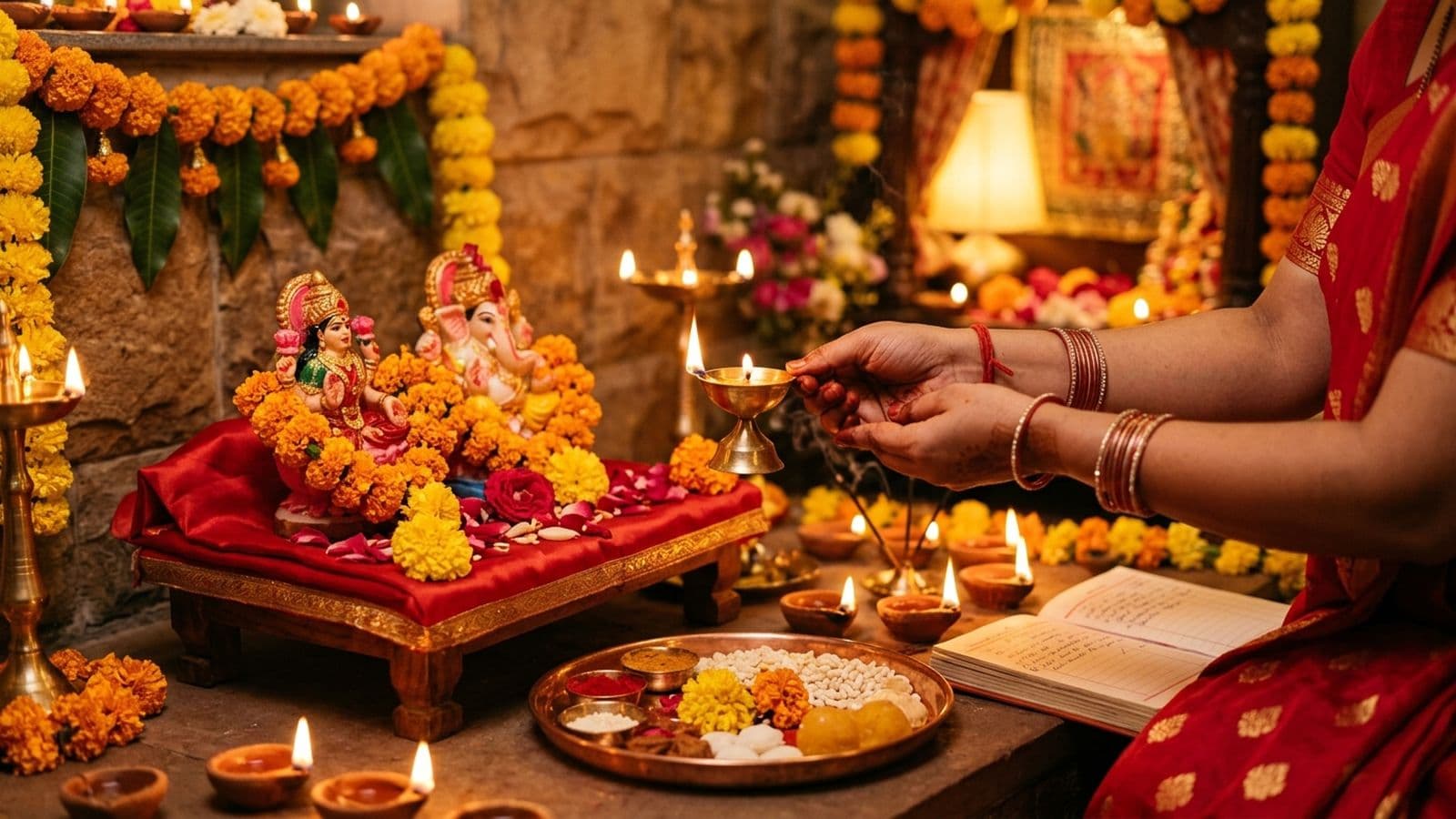
Diwali's Lakshmi Puja is not set by a clock but by two things falling together at dusk. On the evening of Sunday, 8 November 2026 the Kartika amavasya is present right through pradosh kaal — the twilight that opens as the sun goes down — and the pujan is held then, in the sthira, or 'fixed', Vrishabha lagna. The fixed sign is the whole point: Lakshmi, invited into a home during a sthira lagna, is asked to settle and stay rather than move on with the turning sky. The amavasya begins at 11:30 AM on the 8th and runs to 12:33 PM the next day, so it is the 8th, not the 9th, that carries the lamp-lit evening.
Around that evening runs the five-day arc of Deepotsav. Dhanteras opens it on 6 November; Narak Chaturdashi, or Choti Diwali, coincides with Diwali itself on the 8th this year; Govardhan Puja follows on the 10th; and Bhai Dooj closes it on the 11th. The gap before Govardhan is this year's quirk: because the amavasya spills past noon into the 9th, the Shukla Pratipada that Govardhan needs in the morning only arrives on the 10th — two days after Diwali, not the usual next morning.
Diwali 2026 at a glance
Festival day
Sun, 8 November 2026
Tithi
Kartika Amavasya
Lakshmi Puja (Delhi)
5:54 PM – 7:50 PM
Amavasya
8 Nov 11:30 AM → 9 Nov 12:33 PM
Five days
Dhanteras 6 → Bhai Dooj 11 Nov
Govardhan Puja
Tue, 10 November
Lakshmi Puja muhurat, by city
Pradosh and the fixed Vrishabha lagna — for where you are
New Delhi
5:54 PM – 7:50 PM
Pradosh + Vrishabha (sthira) lagna · Pradosh kaal 5:31–7:55 PM
Mumbai
6:01 PM – 8:25 PM
Pradosh kaal · refine to Vrishabha lagna locally
Pradosh kaal is the roughly two-hour twilight that begins at sunset, so like every solar window it opens a little later the further west you sit — 5:31 PM in New Delhi, 6:01 PM in Mumbai. Within it, the Vrishabha (Taurus) lagna is the household's preferred slot for Lakshmi Puja, because that fixed sign holds the goddess in the home; in New Delhi that refines the window to about 5:54 PM to 7:50 PM. Traders keeping the Chopda or Bahi-Khata pujan of their account books often prefer the later Nishita muhurat around midnight instead, when the amavasya is deepest. Confirm your own city's sunset and lagna on the panchang before you light the first lamp.
The five days of Deepotsav
Dhanteras to Bhai Dooj, with dates
Deepotsav runs five days, each with its own tithi and its own rite. Dhanteras, on Friday 6 November, opens it — the day for buying metal, gold or a new utensil, for Dhanvantari, and for the first Yama-deepam. Narak Chaturdashi, or Choti Diwali, falls on Sunday 8 November this year, the same day as Diwali: the pre-dawn abhyanga-snan of Chaturdashi and the evening Lakshmi Puja of the amavasya share the date. Diwali itself, the main Lakshmi-Ganesh pujan, is that evening of the 8th. Govardhan Puja and Annakut come on Tuesday 10 November, honouring Krishna's lifting of the hill. Bhai Dooj closes the arc on Wednesday 11 November — the sister's tilak and prayer for her brother's long life.
The row of lights, and the fixed lagna
Lakshmi's return, and why the timing is so exact
Diwali — from deepavali, 'a row of lights' — marks Lakshmi's return and the welcome laid out for her. The lamps set along the threshold and the parapet are not only celebration; they are a lit path, a house swept and bright, so that Shri, the goddess of fortune, will enter and stay. That is why the timing is so exact. Lakshmi is invoked in pradosh, the meeting of day and night when the amavasya lies deepest, and in the sthira Vrishabha lagna, a fixed sign, so that what is called in becomes settled rather than passing. An older layer of the night is Rama's return to Ayodhya, its people lighting the whole city to guide him home — the same idea, of light making a way for what is longed for. Kept together, the swept house, the steady flame and the fixed lagna all say one thing: stay.
See tonight's panchang and muhurat for your city
The Pradosh and Vrishabha-lagna windows above are for Delhi and Mumbai. For your own city's sunset, amavasya and choghadiya on 8 November — or any day — open the live panchang.
Diwali 2026 — your questions
Dates, muhurat, the five days and Govardhan