
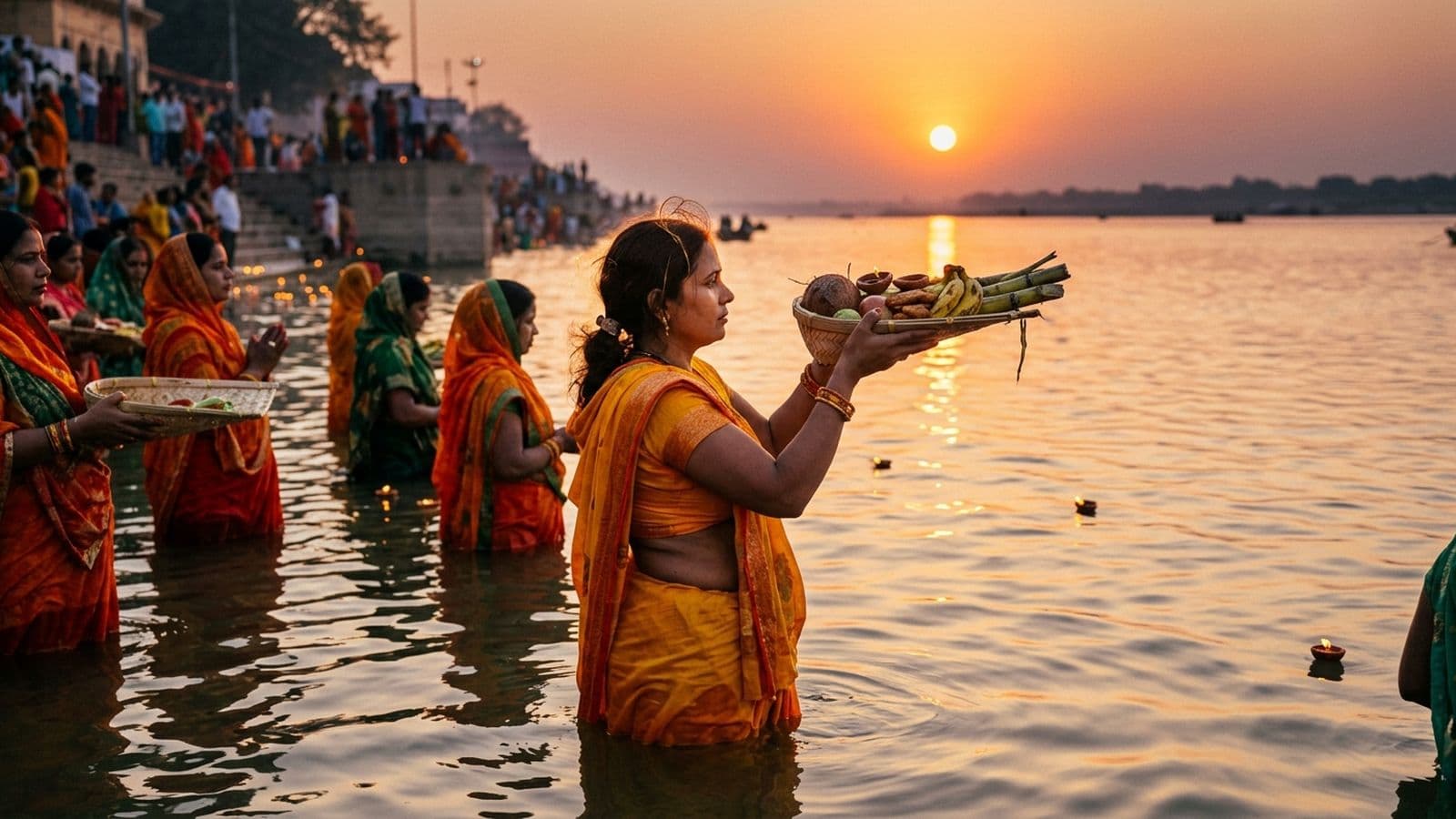
Chhath Puja is the one festival in the Hindu year that bows to the sun as it sets, not only as it rises. Across four days in 2026 — Friday 13 to Monday 16 November — devotees of Surya and Chhathi Maiya keep a vrat with no idol and no priest: the vratti wades into a river or pond and offers arghya to the sun with their own hands. The first great offering, on the evening of Sunday 15 November, goes to the setting sun; the second, at dawn on Monday 16 November, greets it rising. No other major festival honours the sun on its way down.
Because arghya is offered at the exact moment the sun meets the horizon, its time is your city’s own sunset and sunrise — never one national clock. In Patna the setting-sun arghya falls near 5:00 PM and the rising-sun arghya near 6:07 AM; in Mumbai the same offerings come at 5:59 PM and 6:46 AM. Between the two, the vratti keeps a nirjala vrat of about 36 hours — no food and not a sip of water — begun after the Kharna prasad on Saturday night and broken only once the sun has been greeted at dawn.
Chhath Puja 2026 at a glance
Festival days
Fri 13 – Mon 16 Nov 2026
Tithi
Kartik Shukla Chaturthi–Saptami
Worshipped
Surya & Chhathi Maiya
Sandhya Arghya
Sun 15 Nov — setting sun
Usha Arghya
Mon 16 Nov — rising sun
Nirjala vrat
~36 hours, no water
Sandhya and Usha arghya, by city
The offering times are your city’s sunset and sunrise
Patna
Sandhya 5:00 PM · Usha 6:07 AM
Sandhya 15 Nov · Usha 16 Nov
New Delhi
Sandhya 5:27 PM · Usha 6:44 AM
Sandhya 15 Nov · Usha 16 Nov
Mumbai
Sandhya 5:59 PM · Usha 6:46 AM
Sandhya 15 Nov · Usha 16 Nov
Kolkata
Sandhya 4:52 PM · Usha 5:49 AM
Sandhya 15 Nov · Usha 16 Nov
The Sandhya Arghya is offered to the setting sun on the evening of Sunday 15 November, and the Usha Arghya to the rising sun at dawn on Monday 16 November. Because each is tied to the horizon, the clock changes from city to city: Kolkata, further east, sees the sun set and rise earlier than Delhi or Mumbai, while Mumbai’s evening arghya comes almost an hour after Patna’s. The four cities above are the anchor times; for many more cities and the full evening-and-morning table, see the per-city arghya time page.
More cities’ arghya times
The four days of Chhath
Nahay Khay, Kharna, Sandhya Arghya, Usha Arghya
Chhath runs across four days of the waxing Kartik moon. It opens with Nahay Khay on Friday 13 November: the vratti bathes and eats a single sattvic meal, the classic kaddu-bhaat — pumpkin with rice and chana dal. On Saturday 14 November comes Kharna, also called Lohanda — a day of fasting that ends at dusk with a prasad of kheer and roti; the moment that prasad is eaten, the waterless fast begins. Sunday 15 November is the Sandhya Arghya: as the day closes the family walks to the ghat, and the vratti, standing waist-deep in the water, raises a soop of offerings to the setting sun. At dawn on Monday 16 November the Usha Arghya greets the rising sun, and only then is the fast broken with parana. Between Kharna and this last arghya the vratti keeps a nirjala vrat of roughly 36 hours, taking neither food nor water. The offerings are carried in a bamboo soop and daura and centre on thekua — a stiff wheat-and-jaggery sweet — with whole stalks of sugarcane, coconut, banana, seasonal fruit and sindoor.
Surya, Chhathi Maiya and why the setting sun
The Karna and Draupadi katha, and where Chhath is kept
Chhath is worship of Surya, the sun who sustains all life, and of Chhathi Maiya, the goddess of children and wellbeing invoked as his sister. The setting sun is honoured first because gratitude, in this tradition, is owed to the light that has already given the whole day before anything is asked of the light to come — a rare turn that makes Chhath the only major festival to salute the sun as it goes down. The vrat is old: its katha ties it to Karna, the son of Surya, who is said to have stood in water offering arghya to his father, and to Draupadi, who is said to have kept the fast for the wellbeing of the Pandavas. Chhath is observed most intensely in Bihar, Jharkhand, eastern Uttar Pradesh and the Nepal Terai, where the great rivers — above all the Ganga — fill with lamps and soop on these evenings; wherever people from that land have settled, the diaspora keeps the same vrat by whatever water they can reach.
See today’s panchang and sunrise for your city
The arghya times above are for four anchor cities. For your own city’s exact sunrise, sunset and tithi on Chhath — or any day — open the live panchang.
Chhath Puja 2026 — your questions
Dates, arghya times, the nirjala vrat and samagri