
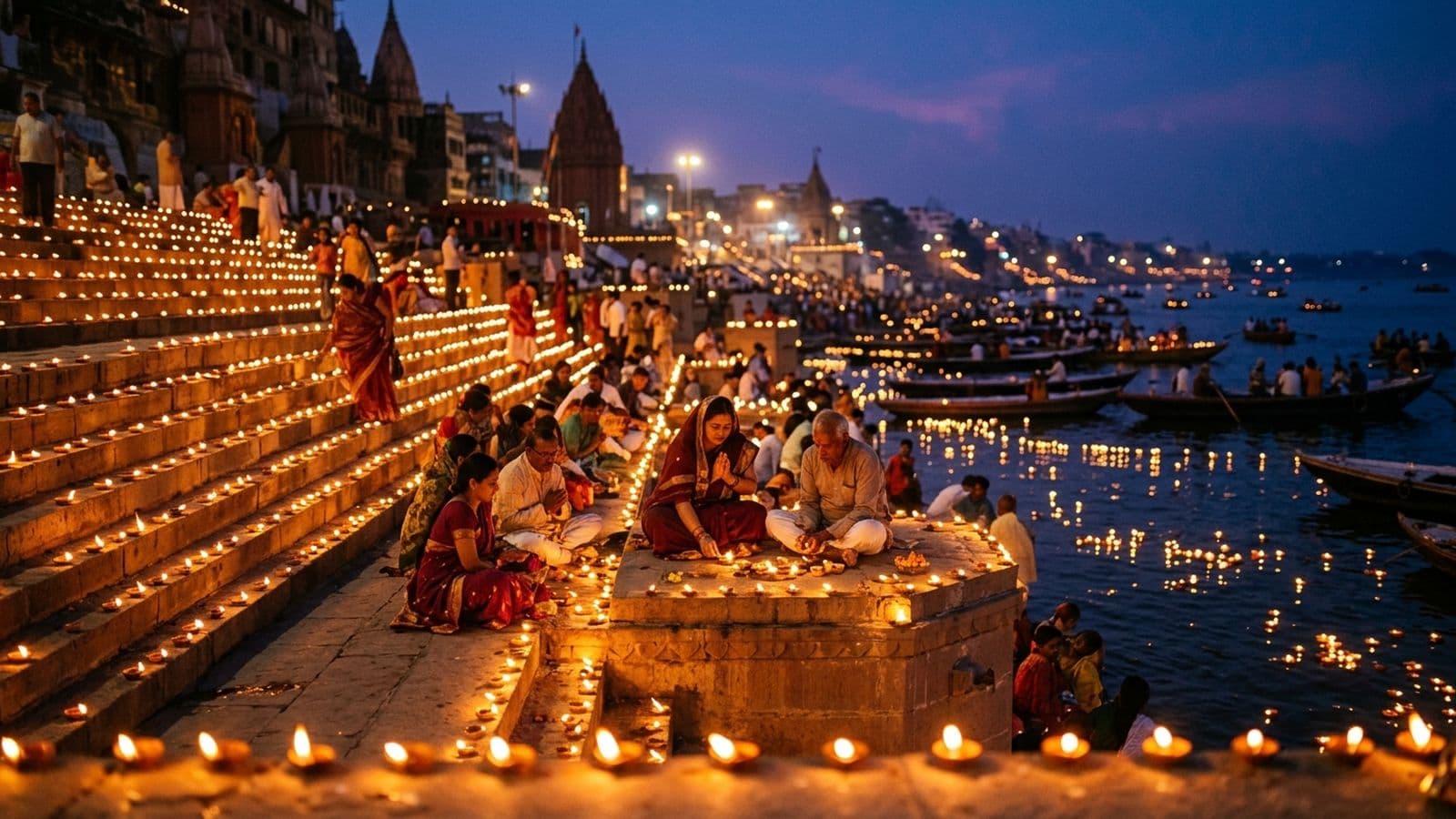
On the evening of 24 November 2026 the stone ghats of Varanasi disappear under lakhs of small earthen flames. This is Dev Deepawali — the Diwali of the gods — kept on Kartik Purnima, the full moon that arrives fifteen days after the Diwali people light for themselves. The tradition holds that on this very tithi the gods came down to earth, to Shiva’s own city of Kashi, to celebrate his victory over the asura Tripurasura, and lined the river’s edge with lamps. Kashi has re-lit them every year since.
The lamps go down in the pradosh — the dusk window that opens with sunset, not after full dark. In Varanasi that is roughly 5:07 to 7:31 PM on the 24th, and a little later to the west, 5:24 to 7:48 PM in New Delhi. Along the ghats the deepdaan runs beside the great Ganga aarti, and diyas are floated onto the water until the current draws a ribbon of light downstream. Kartik Purnima, Dev Diwali, Dev Deepawali — three names for one full moon — and this is the night that closes the Kartik month of lamps.
Dev Deepawali 2026 at a glance
Festival day
Tue, 24 November 2026
Tithi
Kartik Purnima
Deepdaan (Kashi)
Pradosh 5:07 – 7:31 PM
Where
Ghats of Varanasi
New Delhi pradosh
5:24 – 7:48 PM
Occasion
The gods’ Diwali
Deepdaan pradosh window, by city
The dusk hour for the lamps — Kashi first, then Delhi
Varanasi (Kashi)
5:07 – 7:31 PM
Deepdaan pradosh · 24 Nov
New Delhi
5:24 – 7:48 PM
Pradosh window · 24 Nov
Deepdaan is a pradosh rite: the lamps are offered in the dusk window that opens at sunset, so the timing is fixed by when the sun sets where you are, not by a single national hour. In Varanasi the window runs about 5:07 to 7:31 PM on 24 November; in New Delhi, further north and west, it opens a little later, 5:24 to 7:48 PM. On the ghats the deepdaan begins as the Ganga aarti lamps are raised; at home, light the row as the sky is still turning, not at full night.
How the night is kept
Ghat deepdaan, the Ganga aarti and floating diyas
On the Kashi ghats the night becomes a single unbroken line of light. Families and priests set lakhs of earthen diyas along every step from Ravidas Ghat to Rajghat, so the whole crescent of the river glows at once. The deepdaan — the gift of lamps — is offered to the Ganga and to the ancestors, floated on small leaf-boats and let go on the current. It runs alongside the great Ganga aarti, where rows of raised fire-lamps are swung in time to the conch and the bell. Away from the river the night is smaller but the same: a row of lamps at the door and beside any water in the house, a few diyas floated in a bowl, and, as Kartik Purnima, an akash deep — a sky-lamp raised high on a pole.
The gods’ Diwali: Tripurasura, and why Kashi
The legend of the night, and how it differs from Diwali
The night belongs to Shiva. The asura Tripurasura had won three flying, fortified cities and grown almost unconquerable, until on Kartik Purnima Shiva — as Tripurari, the destroyer of the three cities — burned all three with a single arrow. In their joy the gods left the heavens and came down to earth, and the earth-city they chose was Kashi, Shiva’s own. They lit it end to end with lamps, and Dev Deepawali repeats that first divine illumination each year. This is also why it stands apart from Diwali, though the two are only a fortnight apart: Diwali is Kartik Amavasya, the new-moon night of Lakshmi that people light for prosperity — 8 November in 2026 — while Dev Deepawali is the Kartik Purnima that follows, the full-moon night the gods are said to light for themselves.
See the sunset and pradosh for your city
The deepdaan windows above are for Varanasi and Delhi. For your own city’s sunset, pradosh and choghadiya on 24 November — or any day — open the live panchang.
Dev Deepawali 2026 — your questions
Date, the deepdaan window, the legend and Kashi