
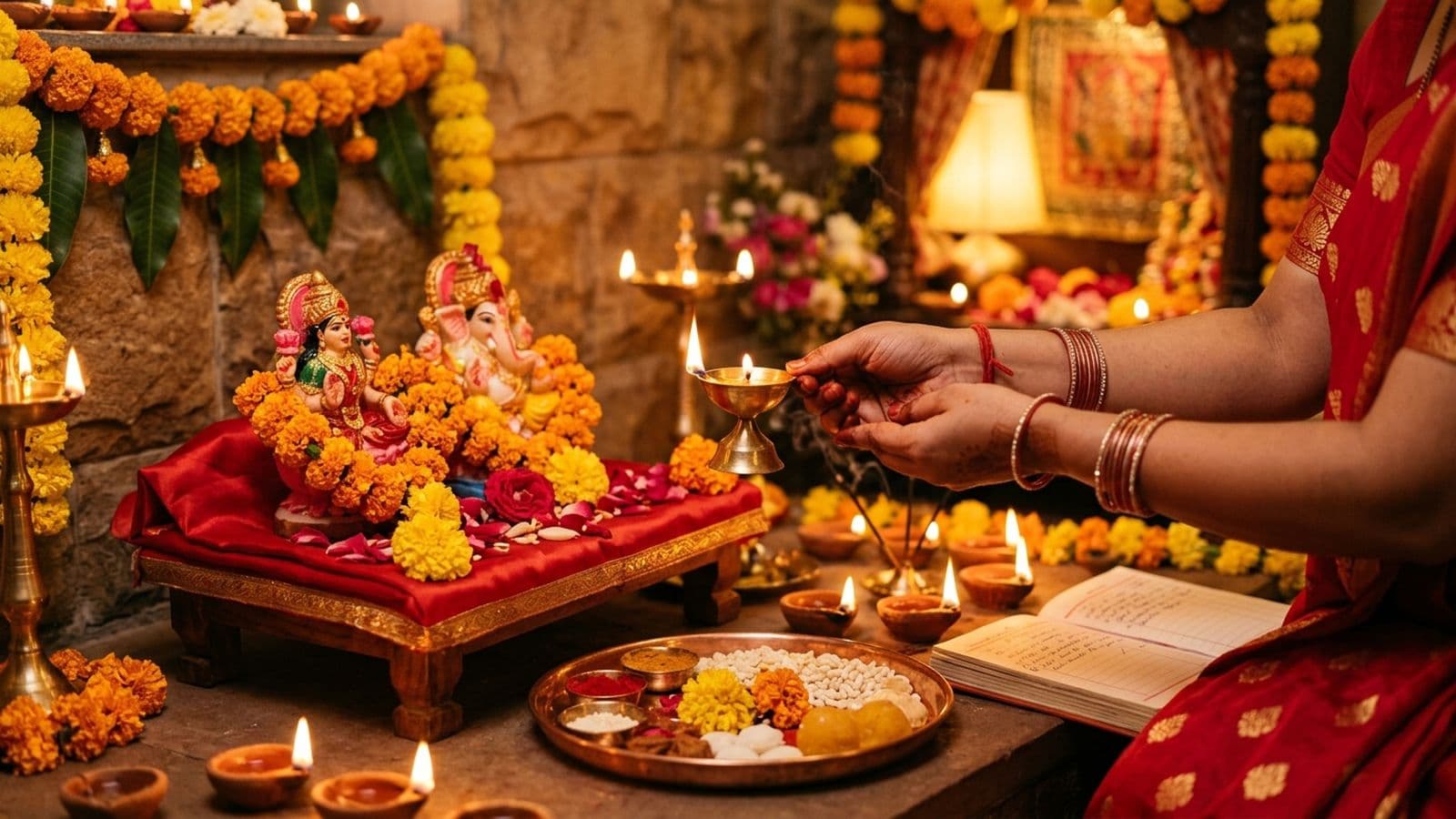
Diwali's Lakshmi Puja begins not with Lakshmi but with the way the chowki is laid. Spread a red cloth over a low wooden seat and set the two idols on it together — Lakshmi in the centre, Ganesha to her left. The order is deliberate: Ganesha is worshipped first, because he is Vighnaharta, the one who clears obstacles, and only a cleared path can hold wealth. Invite Lakshmi into a house still crowded with hindrances and she does not stay; seat Ganesha beside her first, and the fortune she brings has somewhere to settle.
This is the vidhi — the how-to — for that puja, and it stays the same every year; only the muhurat moves. In 2026 the Lakshmi Puja falls on Sunday, 8 November, and it is kept in the pradosh muhurat, the short twilight just after sunset when the lamps are first lit and Lakshmi is welcomed in. What follows is the setup, the samagri you will need, and the step-by-step order of worship — Ganesha, then Lakshmi, often with Saraswati and Kubera — down to the chopda pujan of the account books and the row of diyas set at every door once the aarti is done. For the exact pradosh window in your own city, see the muhurat page linked below.
Diwali Lakshmi Puja at a glance
Puja day
Sun, 8 November 2026
Muhurat
Pradosh, after sunset
Chowki setup
Red cloth, kalash, books
Placement
Ganesh on Lakshmi's left
Worship order
Ganesh first, then Lakshmi
Diyas
Odd number — 11 or 21
When to do it, and what to gather
The date, the pradosh muhurat and the samagri checklist
When to perform
Sunday, 8 November 2026
Kept in the pradosh muhurat — the twilight just after sunset. For the exact window in your city, see the Lakshmi Puja muhurat page.
Samagri checklist
Chowki, Lakshmi-Ganesh, kalash
Plus a red cloth, 11 or 21 diyas, kamal (lotus), kheel-batasha, sweets, coins, and the account books for chopda pujan.
The Lakshmi Puja is an evening rite. It is kept not at dawn but in the pradosh muhurat — the twilight that begins at sunset — because that is the hour when, in household belief, Lakshmi moves from door to door and stays where the lamps are already burning. The house is cleaned and the diyas lit before she is invited, never after. The date shifts each year with the Kartik amavasya; in 2026 it is 8 November. The card beside this lists what belongs on the chowki: gather all of it before you begin, so nothing sends you searching mid-puja.
The puja vidhi, step by step
Sthapana, Ganesha then Lakshmi, chopda pujan and aarti
Begin with the sthapana. Spread the red cloth on the chowki, set the kalash to one side, and place the idols of Lakshmi and Ganesha upon it, with Ganesha to Lakshmi's left. Light the puja lamp.
Then worship Ganesha first — as Prathampujya he is always honoured before any other, so the puja ahead runs without hindrance. Only after him is Lakshmi invited and worshipped, and with her, in many homes, Saraswati for knowledge and Kubera, the keeper of wealth. Offer each the shodashopachar — the sixteen traditional offerings: bathe and dress the deities, offer kamal, the lotus Lakshmi favours, then kheel and batasha, sweets, and coins laid before her.
For a merchant household this is the night of the chopda pujan: the new account books, the bahi-khata, are placed on the chowki and worshipped, so the coming year's trade begins under Lakshmi's eye. Close with the aarti of Ganesha and Lakshmi together. When the puja is done, a row of diyas — an odd number, most often eleven or twenty-one — is carried through the house and set at every door and window, so that the whole home glows and no threshold is left dark for Lakshmi to pass.
Samagri in detail, and the do's and don'ts
Everything that belongs on the chowki, and the mistakes to avoid
The samagri falls into three groups. First, the setup: a chowki, a clean red cloth to cover it, the idols of Lakshmi and Ganesha, and a kalash placed beside them. Second, the offerings: kamal, the lotus that is Lakshmi's own flower; kheel and batasha; other sweets; and coins laid before her as the wealth being honoured. Third, the light: diyas in an odd number — eleven or twenty-one — because an odd count is the auspicious one for the row that will be lit through the house. And on the chowki, for a business household, the account books for the chopda pujan.
A few do's and don'ts steady the rite. Do clean the whole house first, since Lakshmi is invited only into a home that is clean and lit. Do keep Ganesha to Lakshmi's left and worship him first — the order removes obstacles before wealth is invited, and is not a matter of arrangement. Do light the row of lamps at every door and window only after the puja, once Lakshmi has been welcomed, not before. And do not rush the aarti, which closes the invitation rather than merely ending the sitting. Keep the count of diyas odd, and let no threshold stay dark for the night.
See tonight's Diwali muhurat for your city
The pradosh window that fixes when the puja begins shifts with your city's sunset. Open the live panchang for your local Diwali timing, or the Lakshmi Puja muhurat page below.
Diwali Lakshmi Puja — your questions
Setup, order of worship, samagri and timing