
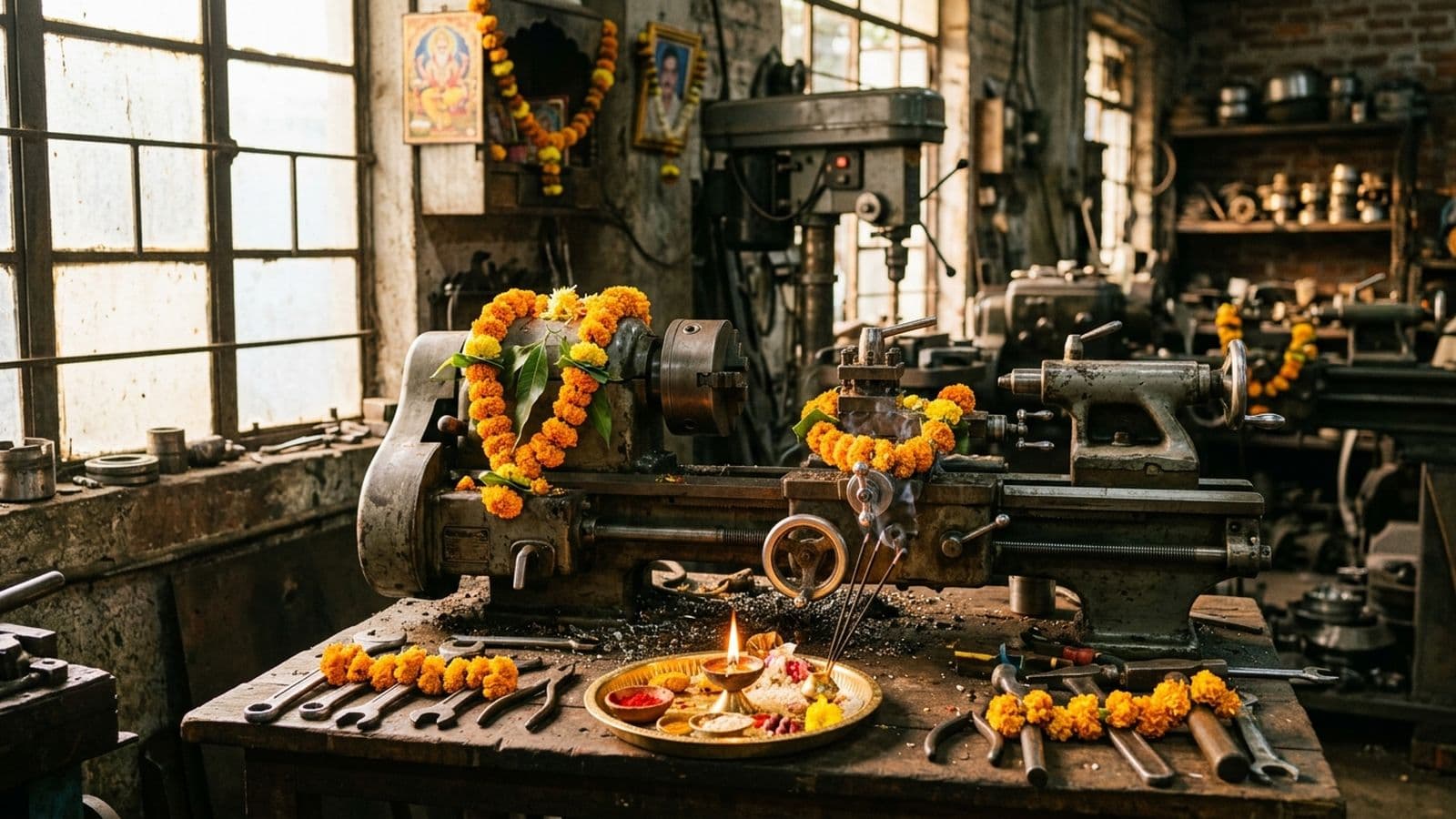
Most Hindu festivals ride the moon, and so they wander across the calendar from one year to the next. Vishwakarma Puja does not. It is a solar festival, pinned to Kanya Sankranti — the moment the sun leaves Simha and enters Kanya, the sign of Virgo. Because the sun's return to that same point takes almost exactly one solar year, the puja lands on 17 September nearly every year, and in 2026 it is Thursday, 17 September.
What sets this day apart is what is worshipped — not so much a murti on a home altar as the tools of one's own trade. On the morning of the 17th the sun crosses into Kanya, and the punya kaal, the auspicious span for the puja and for daan, runs from the forenoon into the early afternoon; the worship of lathes, looms, hammers, vehicles and machines then carries on through the working day. Vishwakarma, the deva-shilpi — the architect and engineer of the gods — is honoured most in the workshops and factories of Bengal, Bihar, Odisha and Jharkhand.
Vishwakarma Puja 2026 at a glance
Festival day
Thu, 17 September 2026
Why it is fixed
Solar festival · Kanya Sankranti
Sankranti moment
Sun enters Kanya, morning of 17 Sep
Punya kaal
Forenoon into early afternoon
The puja
Tools, machines & instruments
Observed most in
Bengal, Bihar, Odisha, Jharkhand
The day, the sankranti and the puja window
Why it holds to 17 September, and the auspicious daytime span
Festival day · Kanya Sankranti
Thu, 17 September 2026
The sun enters Kanya (Virgo) on the morning of the 17th · New Delhi sunrise 06:07, sunset 18:23
Punya kaal · puja window
Forenoon into early afternoon
The auspicious daytime span for the puja and daan; the tool and machine puja carries on through the working day.
Because Vishwakarma Puja is reckoned from the sun and not the moon, it behaves quite differently from festivals like Ganesh Chaturthi or Diwali. Those follow a lunar tithi, which drifts against the Gregorian calendar by ten or eleven days each year; the sankranti follows the sun's steady march through the zodiac, so it returns to the same date almost exactly. In 2026 the sun crosses from Simha into Kanya on the morning of 17 September. There is no single national minute printed for that crossing — different panchangs place it a little apart, and the puja is not tied to one exact instant the way a homam muhurat is. What matters is the punya kaal, the auspicious daytime span it opens: kept from the forenoon into the early afternoon for the puja and for daan, with the tool-worship carrying on through the working day.
The exact sankranti moment
The puja of tools and machines
How the workshop puja is done
The Vishwakarma puja is done at the place of work — the workshop, the factory floor, the garage, the potter's or weaver's shed. The tools and machines are cleaned and rested for the day: lathes and looms are wiped down, engines and vehicles washed, hammers, chisels, needles and instruments laid out. An image or small murti of Vishwakarma is set up with a kalash, and the implements are gathered before it. The worship is simple and direct — roli and akshat, flowers, incense and a lamp, a bhog of sweets and fruit, then the aarti. The machines are kept switched off while they are worshipped, for on this day the tools are not used but honoured. The prasad is shared among the workers, and in many establishments the owner and the hands eat together.
Who Vishwakarma is, and where the day is kept
The divine architect, and the regions that hold the festival
Vishwakarma is the deva-shilpi, the architect and engineer of the gods — the maker of their palaces and cities, of divine weapons like Indra's vajra, of the flying chariots and the very tools by which the world is shaped. In the craftsman's imagination he is the first and greatest of all makers, and so the patron of everyone who builds and mends: carpenters, blacksmiths, potters, weavers, mechanics, masons, engineers and, today, machinists and factory hands. The day is kept most strongly in the industrial and artisan belts of the east — Bengal, Bihar, Odisha and Jharkhand — where community pujas and kite-flying mark it, and in workshops, factories, garages and transport yards across the country. For the working hand it is a day of gratitude: the tool that feeds the household is, for one day, cleaned, garlanded and thanked.
See today's panchang and sankranti timings for your city
The sankranti and punya kaal above are reckoned for New Delhi. For your own city's sunrise, tithi and the auspicious choghadiya on the 17th — or any day — open the live panchang.
Vishwakarma Puja 2026 — your questions
The date, the solar basis, the puja and where it is kept