
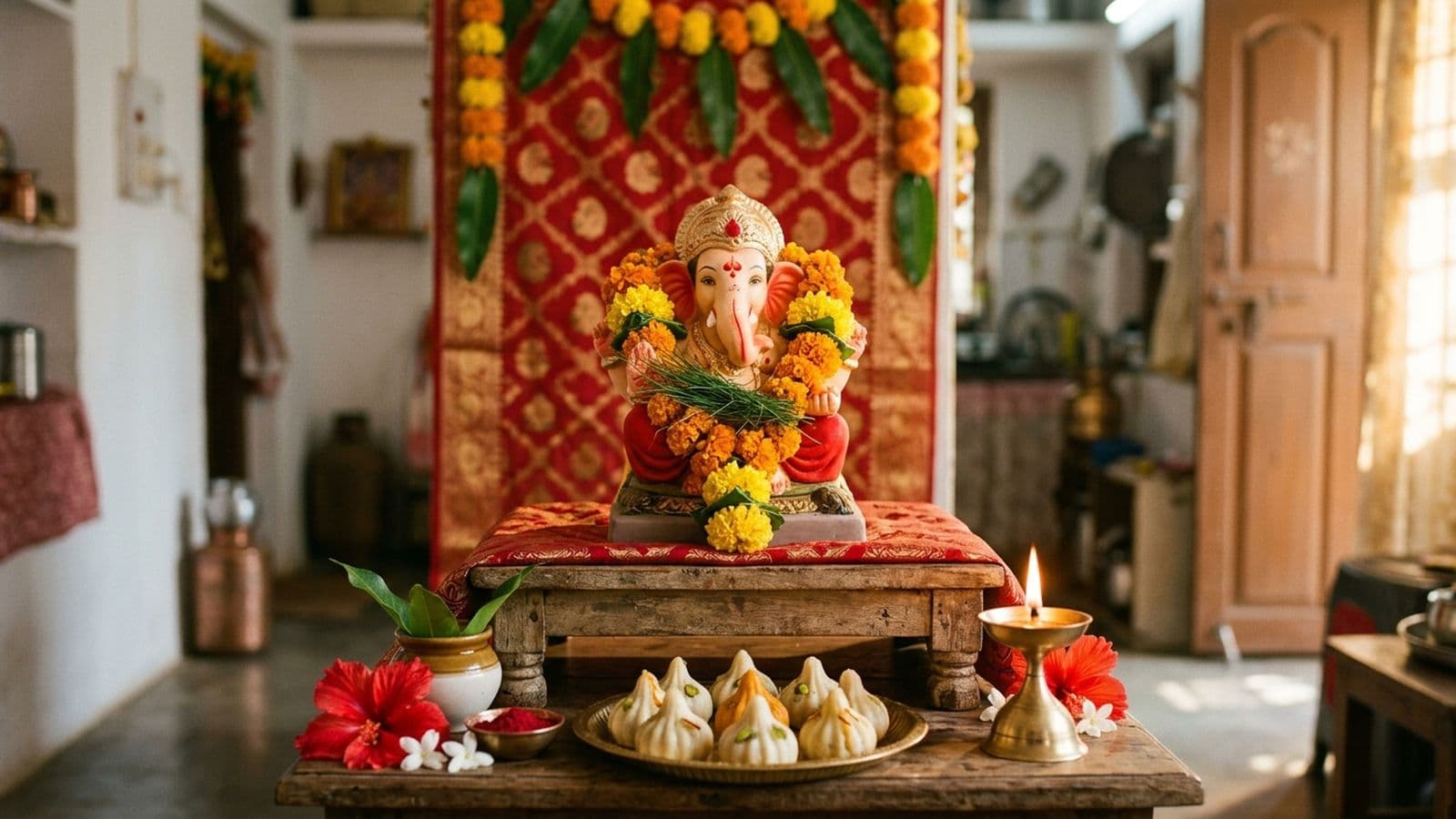
Ganesh Chaturthi in 2026 falls on Monday, 14 September — and the reason it is that Monday says a lot about how the festival is timed. Bhadrapada Shukla Chaturthi is a madhyahna-vyapini vrat: the daytime from sunrise to sunset is divided into five equal parts, and the third, middle part, the Madhyahna, is Ganesha's. The puja is kept on whichever day the Chaturthi covers that middle window. On 14 September the Chaturthi runs from 07:08 that morning to 07:46 the next, so it holds the midday, and that fixes the date.
Because the Madhyahna is measured from your own sunrise and sunset, its muhurat is not a single national time. It opens at 11:02 AM in New Delhi and at 11:20 AM in Mumbai, and shifts a little further west by west. The day carries a second note this year: the Shukla Tritiya ends only at 07:08 on the 14th, so Hartalika Teej shares the date, and the Chaturthi tithi itself spills past midnight into the 15th.
Ganesh Chaturthi 2026 at a glance
Festival day
Mon, 14 September 2026
Tithi
Bhadrapada Shukla Chaturthi
Madhyahna puja
Delhi 11:02 AM – 1:30 PM
Chaturthi
14 Sep 07:08 → 15 Sep 07:46
Avoid the moon
Delhi 9:01 AM – 8:08 PM
Visarjan
Anant Chaturdashi, 25 Sep
Madhyahna puja muhurat, by city
The middle third of the day — computed for where you are
New Delhi
11:02 AM – 1:30 PM
Sunrise · Sunset 06:05 · 18:27
Mumbai
11:20 AM – 1:47 PM
Sunrise · Sunset 06:26 · 18:41
The Madhyahna is the third of the five equal parts the daytime is split into, so its start and end depend entirely on when the sun rises and sets where you live. That is why a single printed time is misleading: the newspapers publish one Delhi window, but in Mumbai the same Madhyahna opens eighteen minutes later. The times above are worked out for each city from that day's sunrise and sunset. If the household cannot gather at Madhyahna, the Abhijit muhurat — a short, always-auspicious window around local noon, 11:51 AM to 12:41 PM in Delhi — is the accepted fallback for the sthapana.
The one day you do not look at the moon
Chandra-darshan nishedh and the Syamantaka katha
Avoid the moon (New Delhi)
9:01 AM – 8:08 PM
14 September — moonrise to moonset
Every month has a Chaturthi, but only on this one is the moon deliberately not seen. The story is the Syamantaka jewel: Krishna was falsely accused of stealing it after he glanced at the moon on Bhadrapada Shukla Chaturthi, because the moon had once laughed at Ganesha and been cursed that whoever saw it this day would carry a false stain, a Mithya Dosha. So the moon is avoided through the day it is up — in New Delhi in 2026 that is roughly 9:01 AM, when it rises, to 8:08 PM, when it sets. If you catch sight of it by accident, the traditional remedy is to recite the Syamantaka verse, which recalls the story and lifts the blame.
Sthapana and puja vidhi
Installing and worshipping the murti at home
Bathe, clean the spot, and during the Madhyahna window place a clay Ganesha on a chowki facing east or north-east. Do the pran-pratishtha to invite the deity into the murti, then the shodashopachar, the sixteen offerings: bathe and dress the murti, offer red flowers and sindoor, lay 21 blades of durva grass, and set a bhog of modak or laddu, the sweets Ganesha is fondest of. Tulsi is the one leaf never offered to him. Light the lamp, read or hear the vrat katha, and keep the morning and evening aarti going for as many days as the murti stays in the house.
Visarjan: how long you keep Ganesha
From 1½ days to Anant Chaturdashi
How long Ganesha stays is a household choice, not a fixed rule. Many immerse after 1½ days, others on the 3rd, 5th or 7th, and the largest visarjan is on the tenth day, Anant Chaturdashi — Friday, 25 September 2026. The count runs from the 14th, and each family keeps to its own tradition. Do the visarjan after a final aarti and a prayer for Ganesha's return next year. A clay murti immersed at home, in a bucket or a tank, keeps the water clean and the ritual whole.
Anant Chaturdashi visarjan muhurat
Why Ganesha is worshipped first
Vighnaharta, and how the festival became public
Ganesha is Vighnaharta, the remover of obstacles, and Prathampujya — worshipped before any other deity at the start of a puja, a wedding or a new venture, so that the work ahead runs smooth. The household vrat is ancient, but the ten-day public festival is not: in 1893 Lokmanya Tilak turned the private Pune puja into a sarvajanik utsav, using the gatherings to build unity during the freedom movement. That is why the pandals and processions run largest in Maharashtra, while much of North India still keeps a quiet one-day home puja.
See today's panchang and muhurat for your city
The Madhyahna and Abhijit windows above are for Delhi and Mumbai. For your own city's tithi, sunrise and choghadiya on the 14th — or any day — open the live panchang.
Ganesh Chaturthi 2026 — your questions
Dates, muhurat, the moon rule and visarjan