
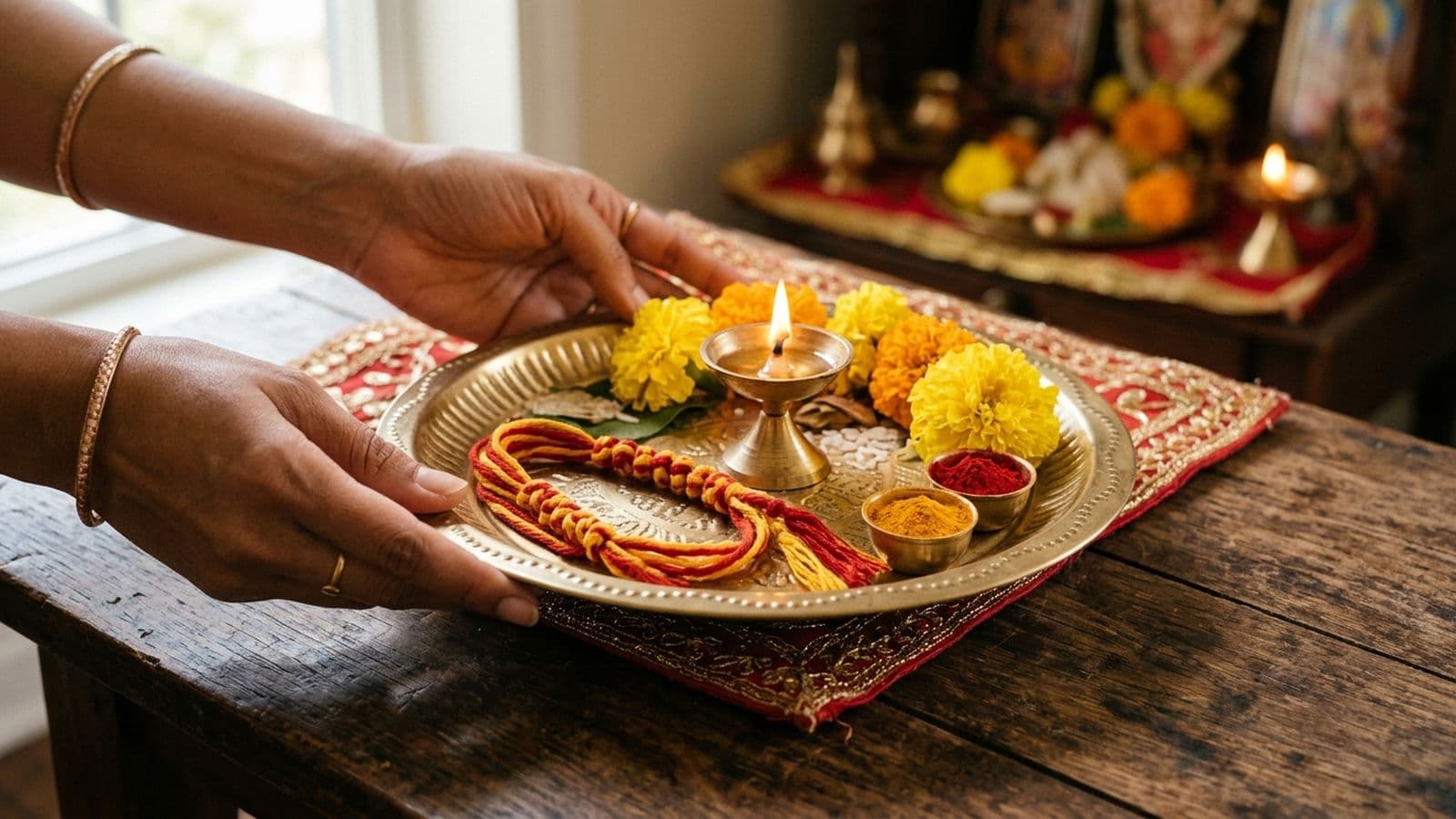
On Anant Chaturdashi the central act is not an immersion but a thread. A cord dyed red or orange is knotted fourteen times, laid before Vishnu through the puja, and then tied on the arm — one knot for each of the fourteen lokas, the fourteen worlds that Ananta, the endless form of Vishnu, holds without beginning or end. Ananta is Vishnu as the boundless: the serpent Shesha on whose coils he reclines is himself called Ananta, the one without limit, and this Chaturdashi of Bhadrapada Shukla is the day set aside to worship that limitless form.
In 2026 that day is Friday, 25 September. The Chaturdashi tithi is already running at sunrise in Delhi (06:11) and does not end until 23:08 that night, so it covers the whole worshipping day — that sunrise presence is exactly why the vrat is kept on the 25th and not the 24th. The same calendar day carries the tenth-day Ganesh visarjan, and the two are easily confused; but Anant Chaturdashi is its own vrat, addressed to Vishnu, with its own thread, its own katha and its own muhurat, all set out below.
Anant Chaturdashi 2026 at a glance
Festival day
Fri, 25 September 2026
Tithi
Bhadrapada Shukla Chaturdashi
Deity
Vishnu, in his Ananta form
Anant sutra
14 knots for the 14 lokas
Puja window (Delhi)
Labh 7:41 – Shubh 1:43
Same day
Ganesh Visarjan (10th day)
Puja windows, by city
The auspicious choghadiya for the thread and the puja
New Delhi
Labh 7:41–9:11 AM · Amrit 9:11–10:42 AM · Shubh 12:12–1:43 PM
Avoid Kaal 10:42 AM–12:12 PM · Sunrise · Sunset 06:11 · 18:14
Mumbai
Labh 7:58–9:29 AM · Amrit 9:29–10:59 AM · Shubh 12:30–2:00 PM
Sunrise · Sunset 06:28 · 18:32
The puja and the tying of the sutra are kept in an auspicious choghadiya. The daytime from sunrise to sunset is divided into eight parts, each ruled by a planet, and of these Labh, Amrit and Shubh are the favourable ones while Kaal is set aside. Because the division begins at your own sunrise, the windows are not one national time: in New Delhi the morning Labh–Amrit runs 7:41 to 10:42 and the midday Shubh is 12:12 to 1:43, with the Kaal from 10:42 to 12:12 to be avoided; in Mumbai, further west, the same sequence opens a little later. Sit for the puja in any one of these, and confirm your own city’s choghadiya before you begin.
The anant sutra and how to keep the vrat
Worshipping Vishnu and tying the fourteen-knot thread
Bathe and clean the place of worship, and set an image or picture of Vishnu — often shown reclining on Ananta, the serpent — with a kalash beside it. The thread itself is the heart of the rite: a cotton cord dyed with turmeric or kumkum and tied with fourteen knots, placed before the deity and worshipped along with him through the offering of flowers, sandal, incense and a bhog. Many keep a day-long fast, taking food only after the puja. When the worship is done, the sanctified sutra is tied on the upper arm — by custom the right arm for men and the left for women — and the previous year’s thread is removed. It is worn until it wears away or is replaced on the next Anant Chaturdashi, a standing reminder of the protection asked of the endless one.
The katha and what ananta means
Yudhishthira in exile, and the endless form
The vrat’s story is told in the Mahabharata: in the forest years of exile, when the Pandavas had lost their kingdom, Krishna advised Yudhishthira to keep the Anant vrat to recover their fortune, and recounted the older tale of the brahmin Kaundinya and his wife Sushila — prosperity that came with the thread, deserted them when it was slighted, and returned when the vrat was kept once more with faith. That is the thread’s promise: continuity restored. The word ananta means without end, and it names both the deity and the reason for the fourteen knots — the fourteen lokas that the endless Vishnu upholds, and, in the reading many families keep, the fourteen years the Pandavas held the vrat before their return. It is why the day belongs to Vishnu, distinct from the Ganesh immersion that happens to fall alongside it.
The same day is Ganesh Visarjan
See the choghadiya and panchang for your own city
The Labh, Amrit and Shubh windows above are for Delhi and Mumbai. For your own city’s sunrise, tithi and choghadiya on 25 September — or any day — open the live panchang.
Anant Chaturdashi 2026 — your questions
Date, the sutra, the muhurat and the visarjan it shares