
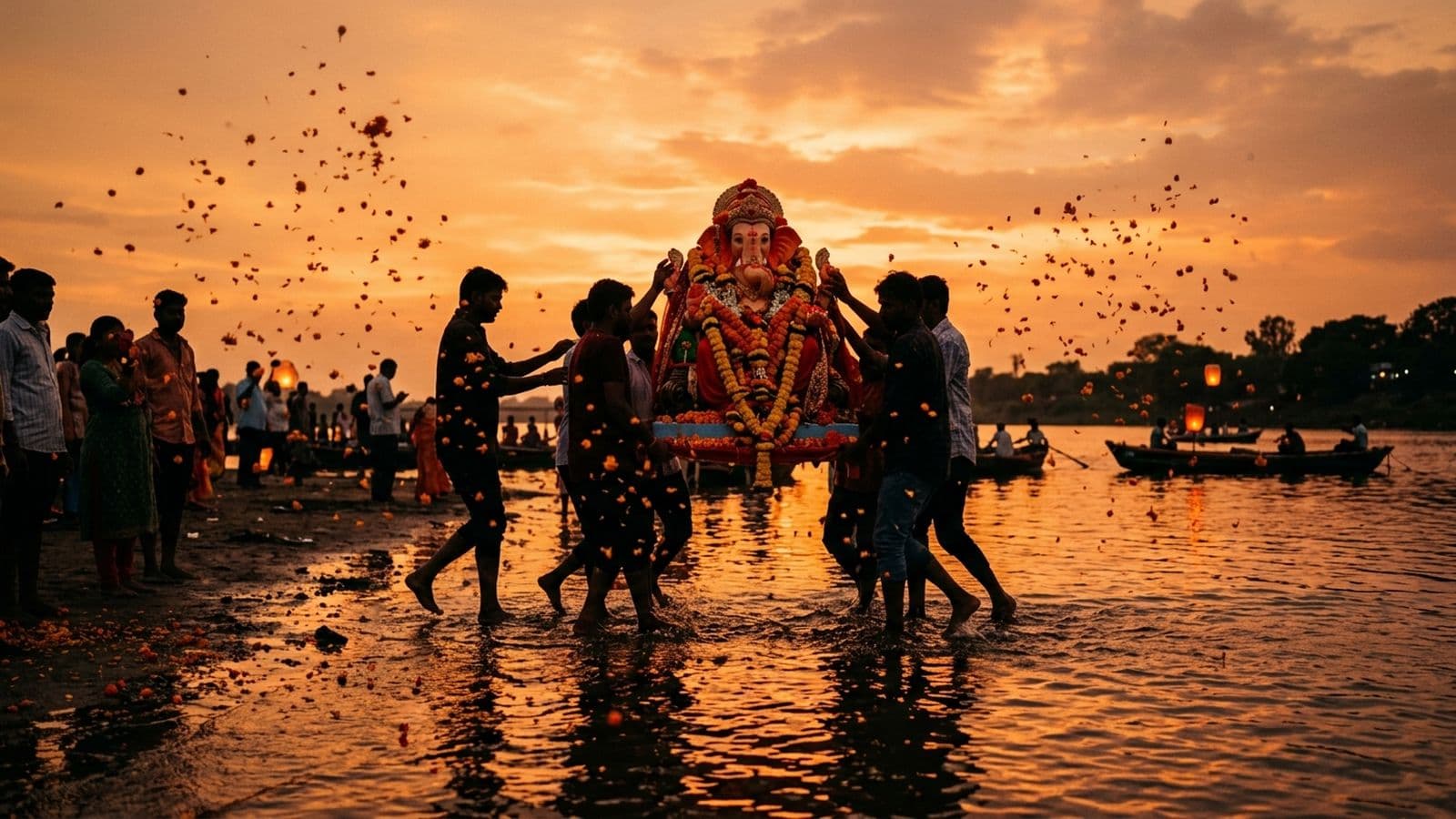
Ganesh Visarjan is the other half of a cycle that opened on Ganesh Chaturthi. When you installed the clay murti, the pran-pratishtha invited the living deity into it — an aavahan, a guest called home. Visarjan is the farewell: after a final uttar-puja and aarti you carry that guest to a river, lake or tank and let the clay dissolve back into the water it was shaped from. That is why the festival ends with immersion and not with storage — the murti was always meant to return to its own element, and Ganesha is sent off with 'Ganpati Bappa Morya, come again soon next year.'
Because it is a farewell and not a tithi-bound sankalp, visarjan has no single muhurat the way the Chaturthi puja has its madhyahna window. The ten-day immersion falls on Anant Chaturdashi — Friday, 25 September 2026, ten days counted from the 14 September sthapana — but the hour is chosen from that day's choghadiya, the auspicious Labh, Amrit and Shubh slices, while Kaal, Rog and Udveg are left alone. This year the Kaal slice in New Delhi runs 10:42 AM to 12:12 PM, sitting squarely between the morning Amrit and the afternoon Shubh, so most households immerse either in the late-morning Amrit that ends at 10:42 or wait for the Shubh window that opens at 12:12.
Ganesh Visarjan 2026 at a glance
Visarjan day
Fri, 25 September 2026
Occasion
Anant Chaturdashi (10-day)
No single muhurat
Rides the day’s shubh choghadiya
Best windows (Delhi)
Labh 7:41 · Amrit 9:11 · Shubh 12:12
Also immerse after
1½ · 3 · 5 · 7 · 10 days
Keep water clean
Clay murti, home immersion
Auspicious visarjan choghadiya, by city
The Labh, Amrit and Shubh windows for the immersion — computed for where you are
New Delhi
Labh 7:41–9:11 AM · Amrit 9:11–10:42 AM · Shubh 12:12–1:43 PM
Sunrise · sunset 06:11 · 18:14 — avoid Kaal 10:42 AM–12:12 PM
Mumbai
Labh 7:58–9:29 AM · Amrit 9:29–10:59 AM · Shubh 12:30–2:00 PM
Sunrise · sunset 06:28 · 18:32
Visarjan is not pinned to one instant, so the practical question is which part of the 25th is auspicious. Read the day as choghadiya — the daytime split into eight slices that rotate through Labh, Amrit, Shubh (all three good), Char (neutral, and fine for a moving procession) and Kaal, Rog, Udveg (left alone). The windows above are worked out for each city from that day's sunrise and sunset, so they shift a little west by west: New Delhi's Amrit ends at 10:42 AM where Mumbai's runs to 10:59. Pick a shubh slice that suits the household, and if the murti is only leaving in a procession, the neutral Char window at first light — from 6:11 AM in Delhi — is commonly used to set out.
How to do the visarjan
Uttar-puja, the procession, and an eco-friendly immersion
Begin with the uttar-puja — the mirror of the installation. Offer a final aarti, sweets and durva, thank Ganesha for the days he stayed, and gently move the murti to signal the farewell; some tie a small potli of rice, coins and modak to send along with him. Carry the murti out — ideally on the head or a shoulder — with the household chant, and at the water lower it in facing the shore rather than throwing it. For a clean immersion, prefer a natural-coloured clay (shadu) murti and immerse it at home in a bucket, drum or tank; once the clay has dissolved, the leftover earth and water can be given to a plant or the garden. A painted plaster murti in a public lake is what fouls the water — the eco choice is smaller, at home, and fully dissolvable.
The same-day Vishnu vrat
How many days you keep Ganesha
The 1½, 3, 5, 7 and 10-day traditions — and why
How long Ganesha stays is the household's own vow, not a fixed rule, and each length carries its own custom. The shortest is the Dedh-din (1½-day) tradition, in which the murti is immersed the morning after the sthapana. Then come the 3rd, 5th and 7th-day immersions — the seventh often coincides with the Gauri visarjan, when Jyeshtha Gauri departs, and is widely kept in Maharashtra. The grandest is the 10th day, Anant Chaturdashi — Friday, 25 September 2026 — when the great public pandals immerse together. Every count runs from your own sthapana on 14 September, and Ganesha is honoured no less whether he is kept a day and a half or the full ten; families simply follow the tenure their house has always observed.
See the choghadiya and panchang for your city
The Labh, Amrit and Shubh windows above are for Delhi and Mumbai. For the live choghadiya on 25 September — or any day — and your own city's sunrise, open the panchang.
Ganesh Visarjan 2026 — your questions
The date, the choghadiya, the immersion and the day-count