
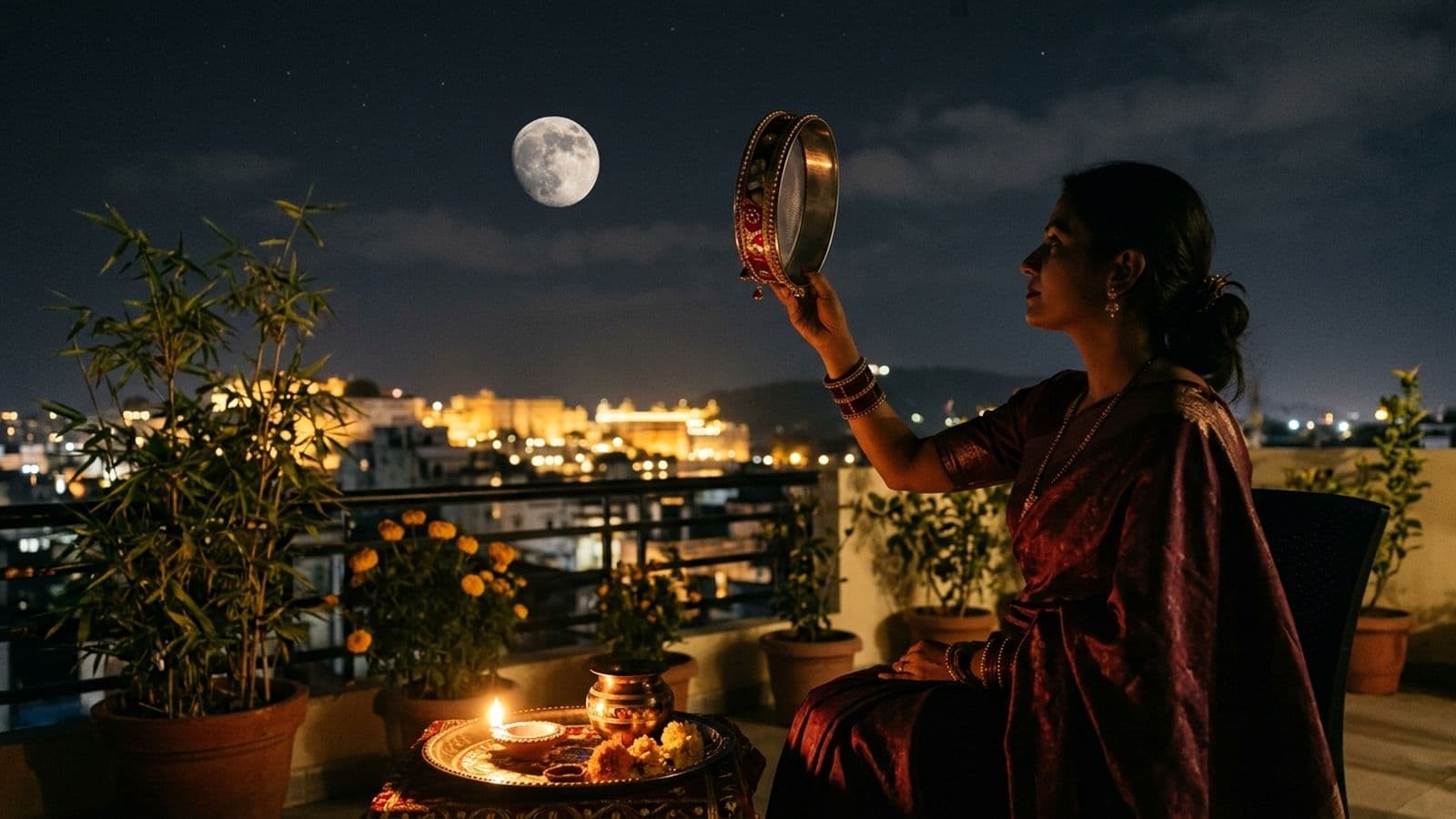
Karwa Chauth is the one vrat whose ending is written by the sky rather than a clock: the fast breaks only when the moon rises, and the moon rises at a different minute in every city. From before sunrise until that first sight of the moon a married woman keeps a nirjala vrat — not a morsel of food, not a sip of water — for the long life of her husband. And she does not simply glance up when the moon comes: she raises a chalni, a sieve, to her eyes, sees the moon through its mesh, then turns and sees her husband’s face through the same mesh, and only then takes water from his hand to end the day.
In 2026 that day is Thursday, 29 October — the Chaturthi of the waning, Krishna fortnight of Kartik, present from about 01:08 that morning to 22:11 at night. The day begins in the dark, before sunrise, around 6:30 AM in New Delhi, with sargi: a plate of food sent by the saas, the mother-in-law, eaten while it is still night so the long fast has something to stand on. What everyone then waits for is the moon — and because moonrise shifts east to west it is not one time. New Delhi sees it about 8:12 PM, Kolkata earlier at 7:42, Mumbai later at 8:56, so the timing that truly matters on Karwa Chauth is the moonrise for your own city.
Karwa Chauth 2026 at a glance
Festival day
Thu, 29 October 2026
Tithi
Kartik Krishna Chaturthi
Sargi
Before sunrise, from the saas
Vrat
Nirjala — no food or water
Puja (Delhi)
Pradosh 5:38 – 6:56 PM
Fast ends
At moonrise · Delhi 8:12 PM
The two timings that shape the day
The pradosh puja window, and the moonrise your fast waits for
Puja muhurat (New Delhi)
5:38 – 6:56 PM
The pradosh (early-evening) window for the katha and the thali
Moonrise — when the fast ends (New Delhi)
8:12 PM
Mumbai 8:56 PM · Kolkata 7:42 PM — full city table on the moonrise page
Two timings shape the evening. The first is the puja muhurat — a short pradosh window in the early evening, 5:38 to 6:56 PM in New Delhi, when the women gather to hear the katha, pass the thali and offer to the karwa. The second, and the one the whole day turns on, is moonrise, because the nirjala vrat is not broken until the moon is seen. That moment is fixed by the sky over your own city, not by any national time: the moon rises around 8:12 PM in New Delhi but nearly three-quarters of an hour later in Mumbai and half an hour earlier in Kolkata. Before you sit, find the moonrise for your own city — a printed Delhi time will leave you either waiting past it or breaking the fast too soon.
Moonrise time for your city
The day, from sargi to the sieve
Sargi before dawn, the nirjala fast, the evening puja, and breaking the vrat
The day runs in a set order. Before dawn comes sargi — the pre-dawn meal the mother-in-law prepares for her bahu, usually fenya or sevai, fruit, dry fruit and sweets, eaten before the sun is up so the body carries something into a foodless, waterless day. From sunrise the nirjala vrat holds: no food and no water until the moon is seen. Through the day the woman dresses in her sixteen shringar, often in her wedding red. In the evening, at the pradosh muhurat, the women of a household or neighbourhood gather for the puja — the earthen karwa, a spouted pot, is filled with water, the thali is readied with a diya, roli, rice and sweets, and the thalis are passed round in a circle as the Karwa Chauth katha is heard. Then everyone waits for the moon. When it rises, the woman raises a chalni, sees the moon through it, offers argh, sees her husband’s face through the same sieve, and takes her first water and food from his hand. That last exchange — moon, then husband, through one mesh — is the image the whole fast is built around.
The katha, and who keeps the vrat
Rani Veeravati, Karwa, and what the fast is for
Two kathas are told on this day. In the story of Rani Veeravati, a beloved sister kept her first Karwa Chauth at her brothers’ home; unable to bear her hunger, the brothers made a false moon — a fire’s glow behind a pipal tree, seen as if it were the real one — so she would break her fast early, and her husband fell gravely ill. Only when she kept the vrat again, fully and truly, waiting for the real moon, was his life restored. In the older story of Karwa, a devoted wife whose husband was seized by a crocodile bound the beast with a thread and, by the force of her devotion, made Yama himself grant her husband long life — and it is from her that the vrat, and the karwa pot, take their name. Both carry the same meaning: the vrat is kept by married women, suhagan, for the long life and wellbeing of the husband, and by many engaged women for a husband-to-be. Newly married women often keep it with special care, and elders guide the first fast. It is, at heart, a day given to the marriage itself.
The full katha of Veeravati and Karwa
See the moonrise and panchang for your own city
The 8:12 PM moonrise above is for Delhi. For the moon’s exact time over your own city on 29 October — and the day’s tithi and choghadiya — open the live panchang.
Karwa Chauth 2026 — your questions
Date, moonrise, sargi, the chalni ritual and the puja