
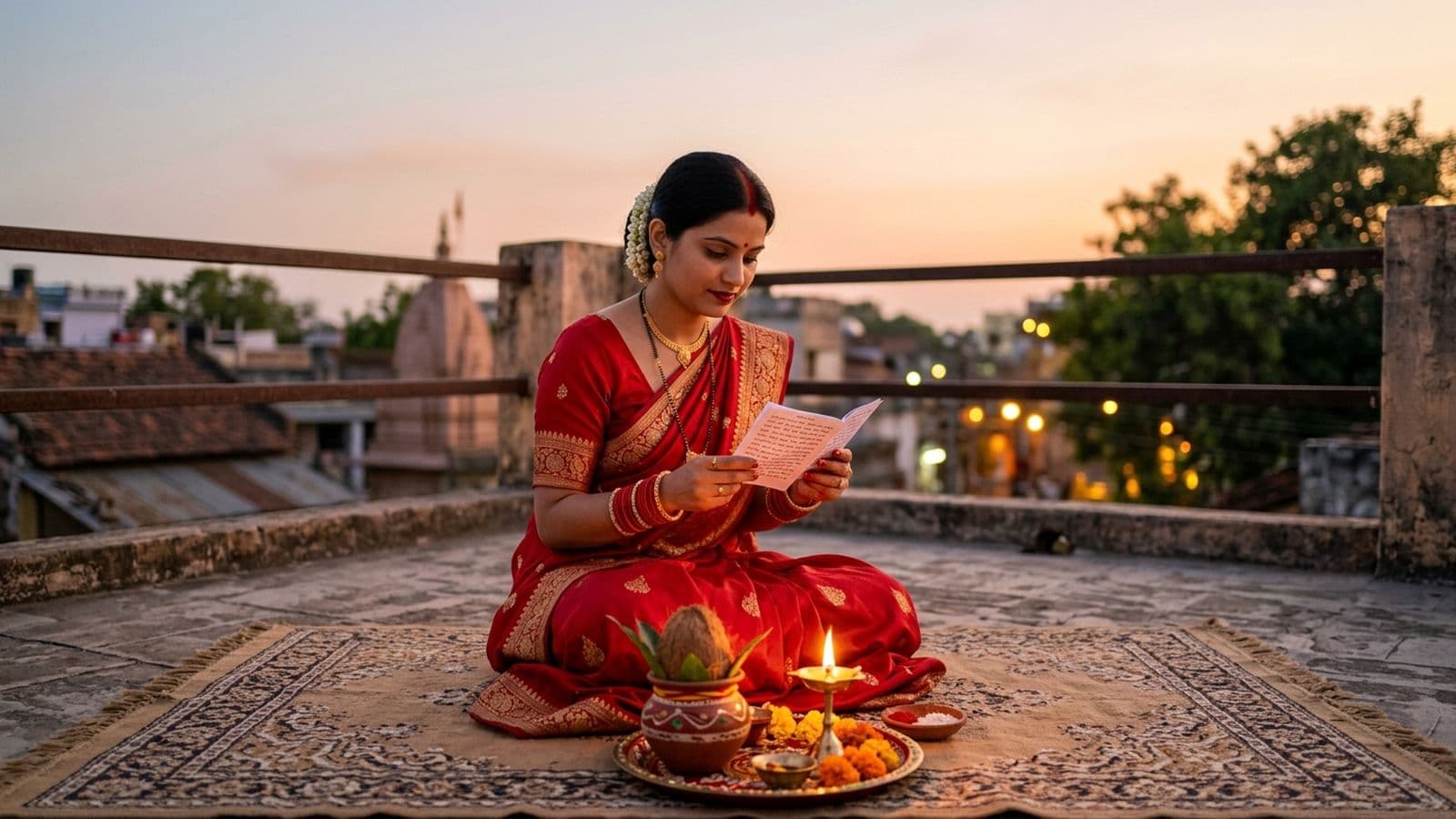
Long before the first star appears on Karwa Chauth, there is a story every fasting woman waits to hear — and it begins with a false moon. Rani Veeravati, the cherished only sister of seven brothers, had kept her first nirjala fast, and by evening she could barely stand. Her brothers, unable to watch her suffer, lit a lamp behind a distant peepal tree so its glow through the leaves would rise like the moon. She saw it, offered her argh, and broke her fast — and in that very moment her happiness turned to grief.
This page is that katha — the story itself, not the dates or the vidhi. It is recited during the evening puja, after the thali is readied and before the moon is sighted, because the vrat is believed to bear fruit only when its story is heard. Two women anchor it: Veeravati, who won her husband back through devotion after the false moon undid her fast, and Karwa, whose satitva was so fierce that Yamraj himself granted her husband a long life. Read them aloud on 29 October 2026, before you raise the chalni to the moon.
Karwa Chauth Vrat Katha at a glance
When read
Evening puja, before moonrise
Karwa Chauth 2026
Thu, 29 October 2026
The two kathas
Rani Veeravati & Karwa
Fast broken at
Moonrise, after argh
Kept for
Husband's long life (suhaag)
Named after
Karwa, the devoted wife
When the katha is read
At the evening puja, before moonrise
When it's read
Evening puja, before moonrise
After the thali is set — so the vrat bears fruit
Karwa Chauth 2026
Thursday, 29 October 2026
The suhaag vrat for a husband's long life
The Karwa Chauth katha is not read at any convenient hour. It belongs to the evening puja — spoken or heard after the puja thali is arranged and before the moon is sighted, so that when a woman finally raises the chalni to the moon and then to her husband’s face, the story’s promise is already fresh in the room. In 2026 that evening is Thursday, 29 October. What follow are the two kathas recited on that night.
The katha of Rani Veeravati
The seven brothers, the false moon, and a fast undone
Veeravati was the only sister of seven brothers, and they loved her past all reason. On her first Karwa Chauth she kept the nirjala fast — no food, not a sip of water — from dawn, waiting like every wife for the moon. But she was young and the day was long, and by dusk she had grown so pale and faint that her brothers could not bear it. Unwilling to watch their beloved sister suffer until moonrise, they slipped away and lit a lamp behind a distant peepal tree, and its glow through the leaves rose like a pale moon. ‘Look, sister, the moon is up,’ they told her. Trusting the brothers who had never once deceived her, Veeravati offered her argh to that false light, turned to her husband in her heart, and broke her fast. In the very hour she ate, word came that her husband had died. Her grief was beyond telling; and it was then she learned the moon had been no moon at all, only a lamp her brothers’ love had lit too soon. But Veeravati did not surrender. She vowed to keep the vrat again, and again, with a full heart and unbroken faith — and by the strength of that devotion her husband was, at last, restored to life. Her story is the reason the fast is never broken until the true moon is seen.
The katha of Karwa and Yamraj
The devotion that gave the vrat its name
The second story gives the vrat its very name. Karwa was a wife of such devotion that her satitva — the power of her faithfulness — was said to move the gods themselves. One day her husband went down to the river to bathe, and a crocodile seized his foot and would not let go. He cried out to Karwa, and she came running. With the strength of her devotion she is said to have bound the crocodile fast with a thread and held it, then went straight to Yamraj, the lord of death, and demanded that the beast be sent to his realm and her husband granted a long life. When Yamraj hesitated, Karwa warned him that the power of a true wife’s devotion could turn upon him — and Yamraj, who fears nothing, feared that. He sent the crocodile to Yamalok and blessed her husband with long years. From her name the vrat is called Karwa Chauth, and the earthen pot a woman fills for the puja is still the karwa. Together the two kathas carry the vrat’s whole meaning: that a fast kept in love and faith reaches even where death waits, and that the story must be heard for the vrat to bear its fruit. That is why, every year before the moon, these words are spoken again.
Time your Karwa Chauth puja for your city
Read the katha at the evening puja, then watch for the moon. For your own city’s moonrise on 29 October and the day’s shubh windows, open the live panchang and choghadiya.
Karwa Chauth Vrat Katha — your questions
When to read it, both stories, and what the vrat means