
Radha Ashtami 2026 falls on Saturday, 19 September — and the hour it is kept tells the whole story. Fifteen days earlier, on Janmashtami, Krishna was born at nishita, the dead of night, on Bhadrapada Krishna Ashtami. Radha appeared on Bhadrapada Shukla Ashtami, the same Ashtami of the bright fortnight, but at madhyahna — the middle of the day. Same tithi number, opposite paksha, opposite hour: his is a midnight janmotsav, hers a midday pragatya. That single fact is why the Radha Ashtami puja is a madhyahna rite and not a midnight one.
Because the appearance is at midday, the observance follows the madhyahna-vyapini rule: the vrat is kept on whichever day the Ashtami covers the midday window. This year the Ashtami runs into the afternoon of the 19th, ending at 3:29 PM, so it holds the midday cleanly and there is no split-date confusion. The madhyahna itself is the middle fifth of the daytime, measured from your own sunrise and sunset — so it opens at 11:01 AM in New Delhi and 11:18 AM in Mumbai. The same morning also begins the sixteen-day Mahalakshmi Vrat, so many households light their first lamp for Lakshmi alongside the Radha puja.
Radha Ashtami 2026 at a glance
Festival day
Sat, 19 September 2026
Tithi
Bhadrapada Shukla Ashtami
Madhyahna puja
Delhi 11:01 AM – 1:28 PM
Ashtami ends
19 Sep, 3:29 PM IST
Mahalakshmi Vrat
Begins today · 16 days
After Janmashtami
15 days · His midnight to her midday
Madhyahna puja muhurat, by city
The middle fifth of the day — computed for where you are
New Delhi
11:01 AM – 1:28 PM
Sunrise 06:08 · Sunset 18:21
Mumbai
11:18 AM – 1:45 PM
Sunrise 06:26 · Sunset 18:37
The madhyahna is the third of the five equal parts the daytime is split into, so its start and end depend entirely on when the sun rises and sets where you live. That is why a single printed time is misleading: the sun rises at 6:08 AM and sets at 6:21 PM in Delhi, and the middle portion of that span opens at 11:01, while in Mumbai — rising and setting a little later — the same window opens at 11:18. Sit for the abhishek and aarti anywhere inside your city’s window. For a place not listed here, split the stretch between your own sunrise and sunset on the 19th into five equal parts and take the middle one, and you have your muhurat.
Puja vidhi, and the vrat that begins today
Worshipping Radha-Krishna, and the Mahalakshmi Vrat
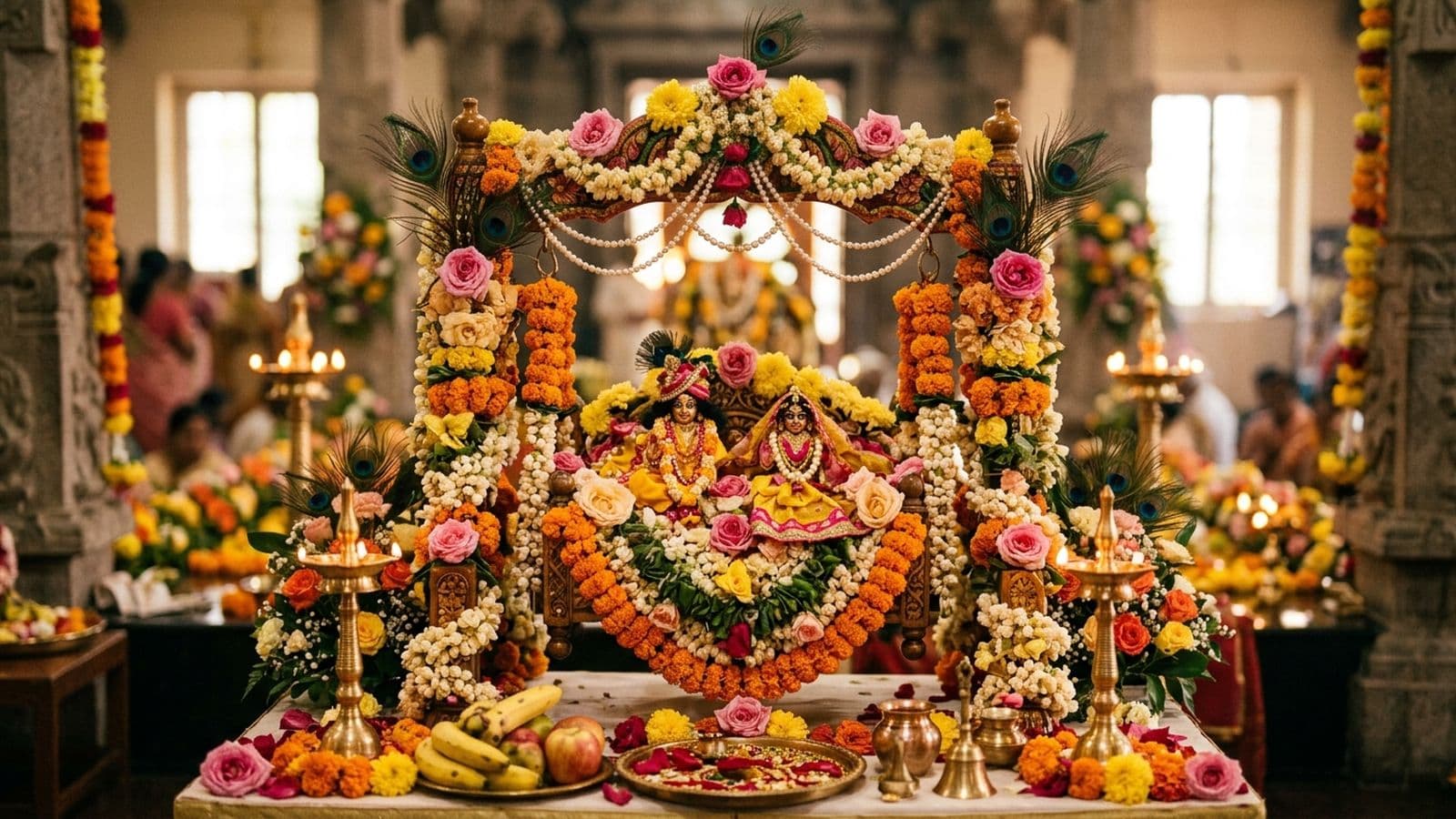
Radha and Krishna are worshipped together as a yugal, and on this one day Radha is named and honoured first — the order the whole tradition reads her name in. Bathe the deities and dress them in yellow, the colour of Bhadrapada’s harvest, and set them on a small jhula wound with flowers, rocking it gently as the bhajan is sung. Offer red and yellow flowers, tulsi and a bhog of panjiri or kheer, and keep the fast on fruit and milk until the midday puja is done. Do the main abhishek and aarti inside the madhyahna window, and read or hear the katha of Radha’s appearance. This same morning opens the sixteen-day Mahalakshmi Vrat, kept from Bhadrapada Shukla Ashtami to Ashwin Krishna Ashtami; households that observe it tie a sixteen-knot thread and begin the daily Lakshmi puja alongside the Radha worship.
Who Radha is, and why her name comes first
Radha tattva, hladini shakti and her appearance
Radha is revered not merely as Krishna’s beloved but as his hladini shakti — the power of his own bliss and love made a person, so that in the bhakti traditions she is inseparable from him and, in a sense, higher, since it is through her that he is loved at all. Tradition holds she appeared rather than was born in the ordinary way: found as an infant by Vrishabhanu and his wife Kirti, and raised at Barsana near Vrindavan, with Raval also honoured as her place of pragatya. To worship Radha is to worship pure devotion itself, and that is why the devotee places her name ahead of the Lord’s — Radha-Krishna, Radhe-Shyam — and why her appearance day is kept with the same tenderness as his birth.
See today’s panchang and muhurat for your city
The madhyahna windows above are for Delhi and Mumbai. For your own city’s tithi, sunrise and choghadiya on the 19th — or any day — open the live panchang.
Radha Ashtami 2026 — your questions
Date, the midday muhurat, puja vidhi and the vrat