
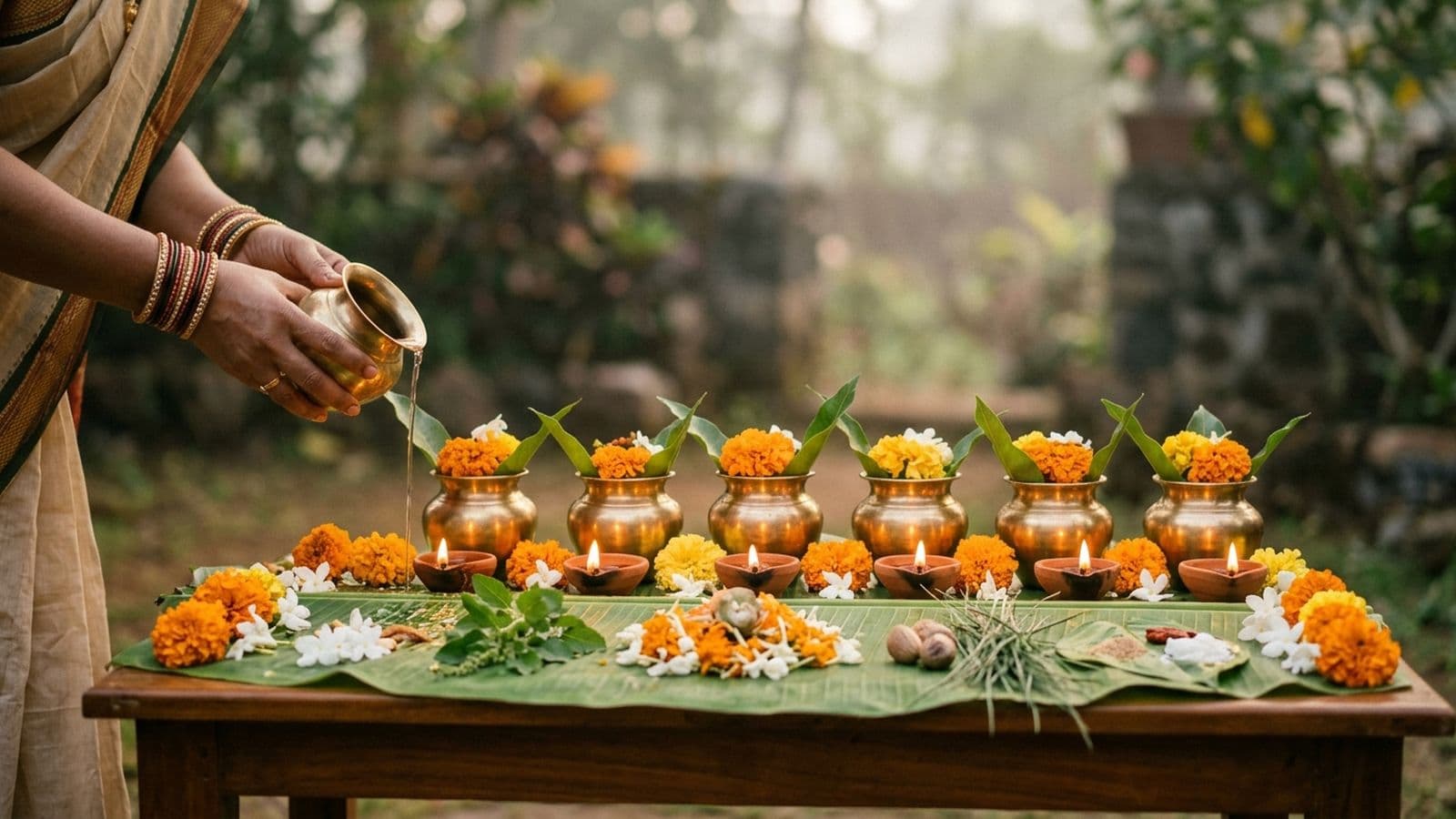
Rishi Panchami is the one day of the year that turns not to a god or goddess but to the Sapta Rishi — the seven sages whose lineages Hindu tradition traces its gotras to — and to Arundhati, the wife of Vasishtha, worshipped beside them. Kept mostly by women on the Shukla Panchami of Bhadrapada, the morning after Ganesh Chaturthi, it is at heart a vrat of shuddhi, of purification: a day to bathe, to fast, and to seek release from the small, unknowing lapses of the year — chief among them the rajaswala dosha, any impurity carried unawares through the days of menstruation.
Like the Chaturthi before it, Rishi Panchami is a madhyahna-vyapini vrat — the puja belongs to the madhyahna, the middle stretch of the day — so the date has to be worked out rather than read off a calendar. In 2026 the Panchami tithi begins at 07:45 on Tuesday 15 September, as the Chaturthi ends, and runs until 09:01 the next morning; so on the 15th it is present through the midday, and the vrat is kept then. Some panchangs print the 16th, but on that day the Panchami ends at 09:01 — long before the madhyahna — so by the madhyahna-vyapini rule, and with Drik Panchang, the 15th is the day.
Rishi Panchami 2026 at a glance
Festival day
Tue, 15 September 2026
Tithi
Bhadrapada Shukla Panchami
Madhyahna puja
Delhi 11:02 AM – 1:30 PM
Panchami tithi
15 Sep 07:45 → 16 Sep 09:01
Honoured
Sapta Rishi & Arundhati
Kept by
Women — a vrat of purification
Madhyahna puja time, by city
The middle of the day — computed for where you are
New Delhi
11:02 AM – 1:30 PM
Sunrise · Sunset 06:06 · 18:26
Mumbai
11:20 AM – 1:47 PM
Sunrise · Sunset 06:26 · 18:41
The Rishi Panchami puja is done at madhyahna, the middle portion of the daylight, and because that portion is measured from your own sunrise and sunset it is not a single national time. In New Delhi the window opens at 11:02 AM and in Mumbai at 11:20 AM, shifting later as you go west. The snan and the resolve to fast are begun earlier in the morning, but the worship of the seven sages is offered in this midday window. The times above are worked out for each city from that day’s sunrise and sunset; for any other town, take the madhyahna from your local panchang.
The vrat vidhi: snan, puja and the fast
How the day of purification is kept
The day opens with the purification snan. By tradition a woman bathes with the datun and leaves of the apamarga plant along with clay and sacred ash, and takes the ritual dip — in many households 108 times, or as many as she can — while remembering the seven sages; the apamarga twig and the earth stand for the washing away of the year’s unknowing impurities. After the bath she cleans a space, sets out the Sapta Rishi with Arundhati, and offers the shodashopachar — water, sandal, a roll of thread, flowers, dhoop, a lamp and naivedya — reading or hearing the Rishi Panchami katha of the sages. The vrat itself is a fast of restraint: the single meal is made only of foods grown without the plough — samak or mordhana millet, wild greens and tubers, fruit and curd — so that nothing eaten owes its growth to the yoking of oxen. Salt is often set aside for the day, and tilled grains are avoided altogether.
The seven sages, Arundhati, and why the day matters
Who is honoured, and the meaning of the vrat
The seven honoured on this day are the Sapta Rishi — Kashyapa, Atri, Bharadvaja, Vishvamitra, Gautama, Jamadagni and Vasishtha — the sages the sky holds as the seven stars of the Saptarishi, the Great Bear, and the ancestors whose gotras most Hindu families still name themselves by. Beside them is worshipped Arundhati, Vasishtha’s wife, the faint star that rides close to his in that same constellation and the tradition’s image of steadfast devotion. To bow to them is to thank the keepers of knowledge, penance and dharma. And the vrat’s purpose is shuddhi: it is kept to atone, gently and without shame, for the small lapses no one intends across a year — most of all the rajaswala dosha, the impurity a woman may unknowingly carry from the days of her monthly cycle. Older than the Ganeshotsav crowds it now sits within, Rishi Panchami keeps its quiet, inward shape: a bath, a fast, and a namaskar to the sages.
See today’s panchang and madhyahna for your city
The madhyahna windows above are for Delhi and Mumbai. For your own city’s tithi, sunrise and the midday muhurat on 15 September — or any day — open the live panchang.
Rishi Panchami 2026 — your questions
The date, the puja time, the fast and the sages