
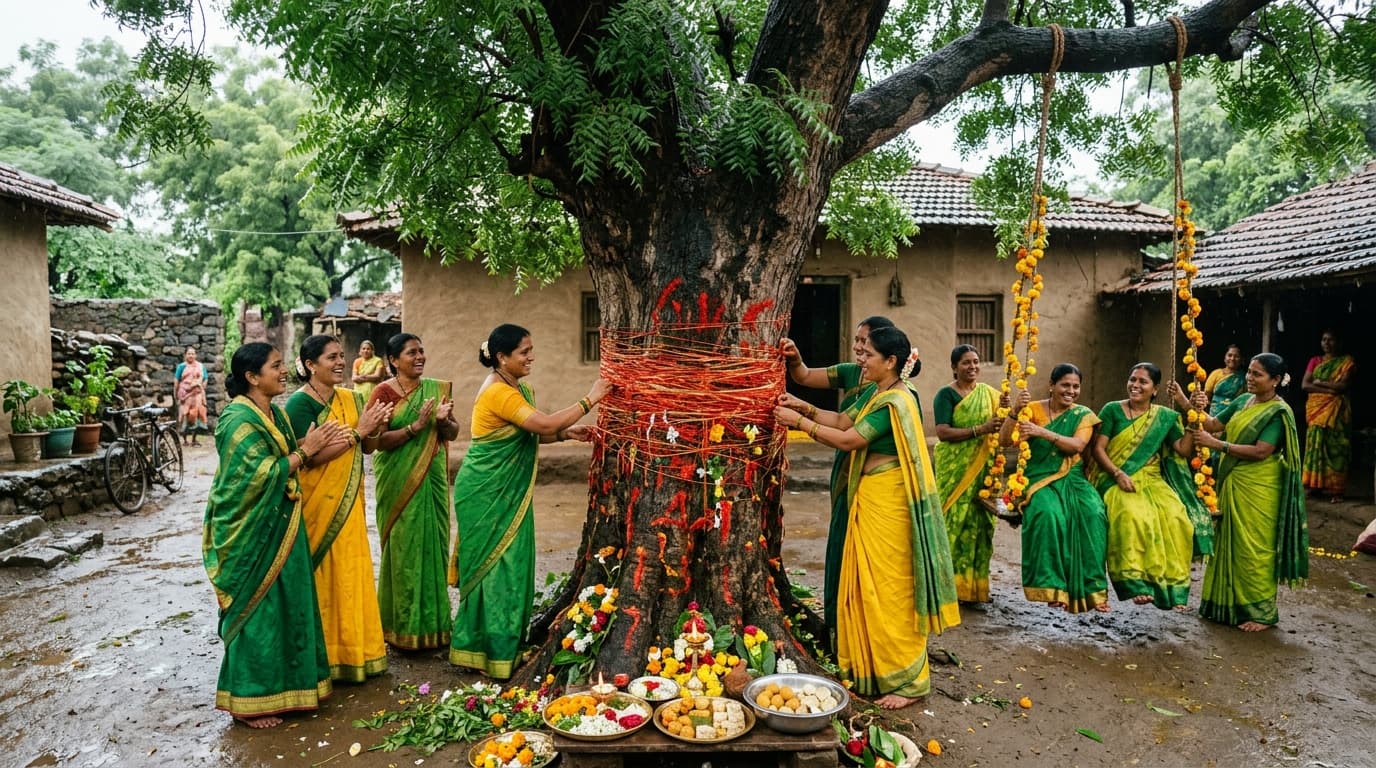
Kajari Teej is the folk-hearted middle Teej — less austere than Hartalika, more rooted in regional song and community than Hariyali. Falling on the Krishna Tritiya of Bhadrapada, it is known by several names: Kajali Teej after the monsoon folk songs, Satudi Teej after the sattu offerings in parts of UP and Rajasthan, and Badi Teej simply because it falls between the other two.
In 2026, Kajari Teej falls on Monday, 31 August. Below are the exact Bhadrapada Krishna Tritiya timings for New Delhi, the Neem-puja vidhi, the phalahar vrat rules, the kajari folk-song tradition, and how this Teej differs from Hariyali and Hartalika.
Kajari Teej 2026 at a glance
Festival day
Mon, 31 August 2026
Tithi
Bhadrapada Krishna Tritiya
Tritiya begins
30 Aug, 09:38
Tritiya ends
31 Aug, 08:52
Central ritual
Neem tree worship
The fast
Phalahar (fruit fast)
Sunrise · Sunset
05:58 · 18:44
Also called
Kajali Teej, Satudi Teej
Kajari Teej 2026 date & tithi timings
The Bhadrapada Krishna Tritiya window and sunrise
Krishna Tritiya
30 Aug 09:38 → 31 Aug 08:52
Bhadrapada, New Delhi
Sunrise · Sunset
05:58 · 18:44
31 August, New Delhi
In 2026 the Krishna Tritiya of Bhadrapada begins at 09:38 on 30 August and ends at 08:52 on 31 August (New Delhi). Because the Tritiya is present at sunrise (05:58) on the 31st, Kajari Teej is observed on 31 August. Unlike Hartalika Teej, there is no specific pradosh or nishita muhurat — the Neem puja is done during the day, and women gather for kajari singing in the evening. Since sunrise times vary by city, confirm your local panchang.
Kajari Teej vrat vidhi & Neem puja
How the phalahar vrat is kept and Neem-mata worshipped
Women rise early, bathe, and put on festive clothes — often green, the colour of the monsoon. The vrat is a phalahar fast: fruit, milk, dry fruit and sendha-namak dishes are allowed, making it gentler than the nirjala fast of Hartalika Teej. The centrepiece is Neem-puja: women go to a Neem tree, clean the area around it, and decorate the trunk with sindoor, roli, turmeric and a sacred thread. They offer sweets, fruit, flowers and sometimes sattu, then circle the tree seven times in prayer, asking for the long life and wellbeing of their husband and family. In many households a small Neem branch is brought home and worshipped on a chowki. The fast is broken the next morning after a brief puja. Regional practices differ — in some areas, women also worship a pot of water under the Neem, or make offerings of kajari sweets — so follow your family tradition where it varies.
The kajari folk-song tradition
Monsoon songs, swings and community
Kajari is a genre of monsoon folk songs native to the Vindhya and Bundelkhand belts of Uttar Pradesh and Madhya Pradesh. The songs celebrate the rains, the ache of separation, the joy of reunion and devotion to Shiva and Parvati — sung in a lilting call-and-response style, often while swinging on jhulas hung from trees. On Kajari Teej, women gather in courtyards or under a large tree to sing them through the evening, keeping the monsoon-song tradition alive across generations. In cities the custom has thinned, but in the rural Vindhya and Bundelkhand heartland it remains a vivid communal festival. The songs themselves gave the festival its name: Kajari Teej is the Teej of the kajari.
Significance and the three Teejes
Why Kajari Teej matters
Kajari Teej sits between the two more widely known Teejes and carries its own distinct character. Where Hariyali Teej is green and joyful and Hartalika Teej is austere and devotional, Kajari Teej is rooted in folk tradition — the Neem worship, the regional songs, the gathering of women under a tree. It is kept mainly in the Vindhya belt, parts of Rajasthan, Bihar and eastern UP, and is less common in urban India. Married women keep it for their husband's long life; unmarried girls for a good match. If a marriage is being considered in your family, our Kundali Matching tool gives a Vedic guna-milan and compatibility summary.
If marriage is on your mind
Check the Teej timings for your city
These timings are for New Delhi. For your city's sunrise, sunset, tithi and auspicious windows, use our live tools.
Frequently asked questions
Kajari Teej 2026 date, vidhi and tradition