
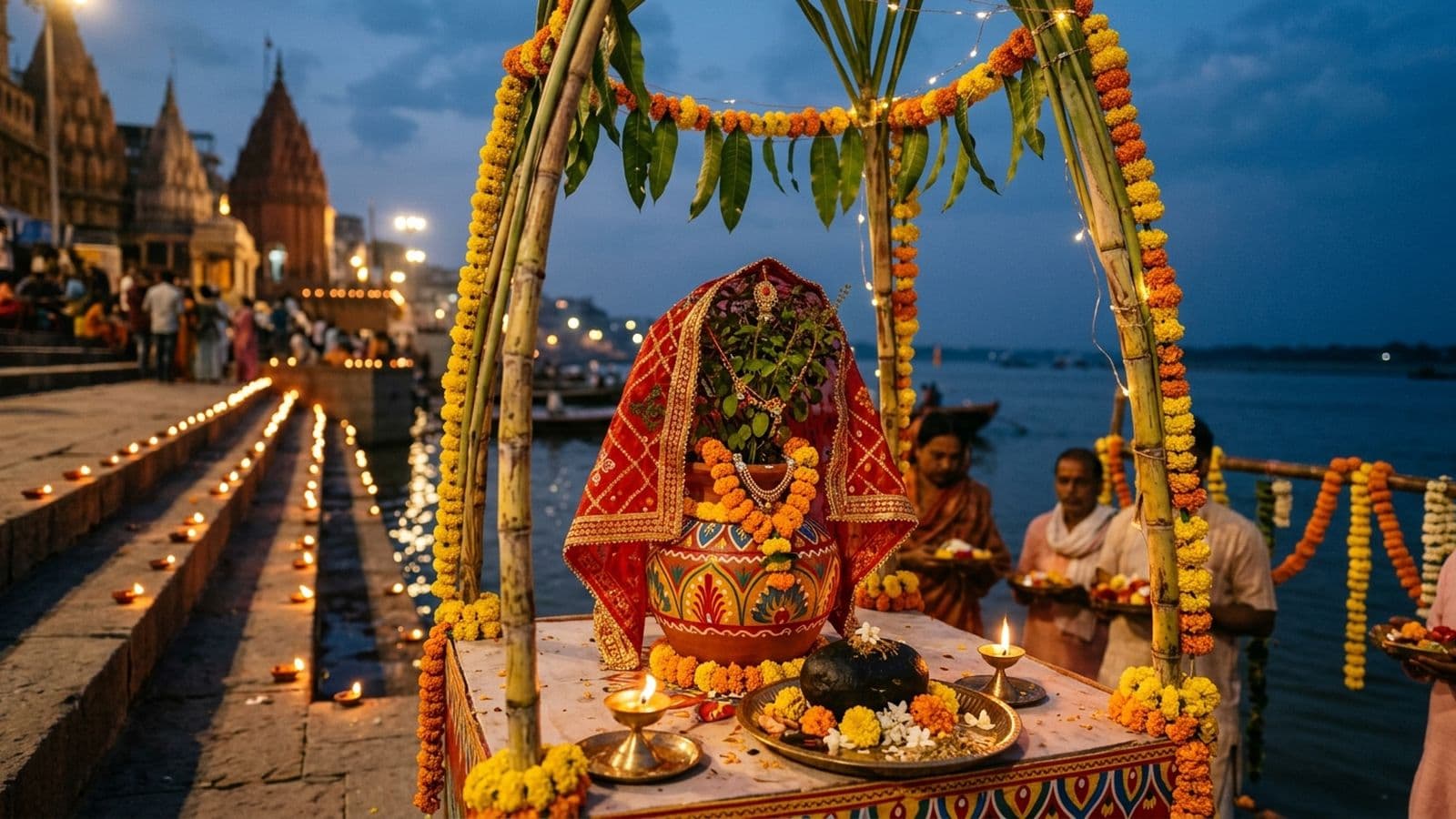
Tulsi Vivah is not a fast or a noon puja but a wedding. The household marries the tulsi plant in its courtyard to Shaligram, the black stone that is Vishnu, and it does so at dusk, in the pradosh — the same twilight hour at which a Hindu bride and groom take their vows. The tulsi, revered as Vrinda, is dressed as a bride; her pot is wrapped and canopied; a mandap of standing sugarcane is raised around it; and the family gives her away in kanyadaan to the god.
In 2026 that wedding falls on Saturday, 21 November — Kartika Shukla Dwadashi, the tithi beginning at 06:32 that morning — the day after Dev Uthani Ekadashi wakes Vishnu and lifts the four-month pause of Chaturmas. That timing is the whole point: through Chaturmas no marriages were solemnised, and Tulsi Vivah is the first of the resumed season, the model wedding whose completion reopens the human wedding calendar. Some families keep it on Dev Uthani Ekadashi itself (20 November); the Dwadashi is the day most widely followed.
Tulsi Vivah 2026 at a glance
Festival day
Sat, 21 November 2026
Tithi
Kartika Shukla Dwadashi
Dwadashi from
06:32, 21 Nov (Delhi)
The rite
Tulsi wed to Shaligram
Pradosh (Delhi)
5:25 – 7:49 PM
Marks
Wedding season reopens
Tulsi Vivah pradosh muhurat, by city
The twilight window when the marriage is performed
New Delhi
5:25 – 7:49 PM
21 Nov, evening
Mumbai
5:59 – 8:23 PM
21 Nov, evening
Pradosh is the span of twilight that begins as the sun sets and runs into the early night — about two and a half hours in which day gives way to dark. A wedding is by tradition solemnised at such a joining hour, and so the tulsi’s is kept in pradosh rather than at midday. Because it opens at your own sunset, the window is not one national time: it runs 5:25 to 7:49 PM in New Delhi and, further south and west, 5:59 to 8:23 PM in Mumbai. Set the marriage anywhere within it, and confirm your own city’s sunset and pradosh before you begin.
The vivah vidhi — marrying Tulsi to Shaligram
The bride, the sugarcane mandap and the kanyadaan
The rite follows a human wedding step for step. The tulsi in its courtyard pot is bathed and dressed as a bride — a red chunari draped over the plant, bangles and a bindi set on the pot, vermilion and turmeric applied. Four stalks of sugarcane are stood at the corners and joined overhead into a mandap, the canopy under which the marriage is performed. Shaligram — the black ammonite stone that is Vishnu, or a small brass image of Krishna in its place — is brought to her as the groom. The couple are joined as any couple would be: the phere are walked around the pot, a sacred thread or mangalsutra is tied, and the householders perform the kanyadaan, giving the tulsi away as they would a daughter of the house. The Vrinda katha is read, amla, ber and sugarcane are offered, and the evening closes with aarti and the sharing of prasad.
Why the wedding season reopens here
Chaturmas ends, and the first marriage is kept
For the four months of Chaturmas, from Devshayani Ekadashi in Ashadha, Vishnu is held to sleep and the auspicious calendar is stilled — no weddings, no griha pravesh, no new ventures. Dev Uthani Ekadashi wakes him and lifts that pause, and Tulsi Vivah, kept the very next day, is the act that formally reopens the season: the first marriage of the year, whose completion is felt to clear the way for every human wedding to follow. The story behind it is Vrinda’s. Devoted wife of the asura Jalandhar, her chastity made him invincible; to end him the gods needed that devotion broken, and Vishnu did so by deceit. The wronged Vrinda, on leaving the world, took the form of the tulsi plant, and Vishnu vowed that he would wed her each year in his Shaligram form — the vow that Tulsi Vivah keeps. It is why the tulsi in the courtyard is the most honoured plant of the Vaishnava home, tended as Vrinda herself, a living guardian of the household.
Planning a wedding this season?
See the pradosh and panchang for your own city
The pradosh windows above are for Delhi and Mumbai. For your own city’s sunset, tithi and choghadiya on 21 November — or any day — open the live panchang.
Tulsi Vivah 2026 — your questions
Date, the pradosh muhurat, the vidhi and the season